
A walk-in closet is the first room you visit every morning and the last one you tidy every night — so it deserves better than wire shelving and a bare bulb. These luxury walk-in closet ideas borrow the tricks of high-end boutiques: flattering light, a calm palette, and displays that make your own clothes look like the merchandise.
You do not need a celebrity-sized space. Most of these ideas scale down to a modest dressing room or a generous reach-in closet — what matters is intention, not square footage.
1. Light It Like a Boutique

Boutiques never rely on a single ceiling bulb, and neither should your closet. Layered lighting is the fastest way to make a closet feel expensive.
How to do it: Start with a small statement fixture — a crystal mini-chandelier or an alabaster flush mount — at the center of the room. Then add warm LED strips (2700K) under every shelf and along the top of hanging sections so clothes are lit from within, not just from above. Put everything on a dimmer: bright for choosing outfits, low for evening calm. Our luxury lighting design ideas walk through layered lighting room by room.
What to avoid: Cool-white or daylight bulbs — they make skin look sallow and fabrics look cheap. A single overhead panel turns a closet into a stockroom.
2. Keep the Palette Calm and Collected
Boutiques sell serenity before they sell clothes. A calm palette lets your wardrobe be the color in the room.
How to do it: Paint walls, built-ins, and ceiling in one enveloping neutral — warm white, greige, or soft taupe. Keep hardware consistent (brushed brass or matte black throughout). If you crave contrast, add it in exactly one place: a dark-stained island, an emerald ottoman, a vintage rug.
What to avoid: Mixing wood tones and metal finishes at random. Pick one metal and one wood tone, then repeat them — cohesion reads as luxury.
3. Add a Center Island with Glass-Top Drawers
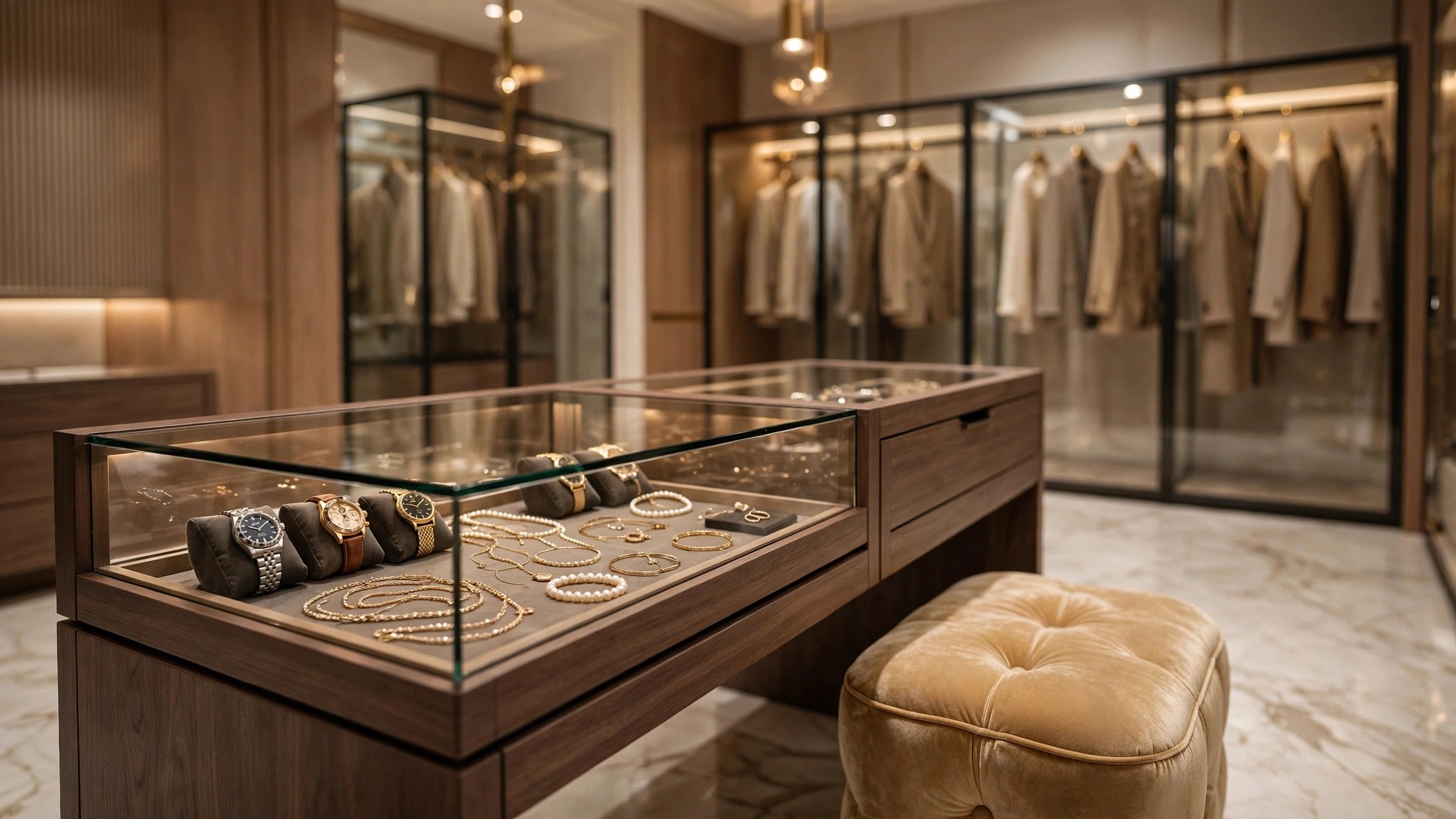
Every great boutique has a display table. A center island turns dead floor space into the room’s jewelry box.
How to do it: Choose an island about 24 inches deep with glass-top drawers for watches, sunglasses, and folded delicates. Style the top surface with a tray for perfume, a small orchid, and a stack of fashion books. This is also the natural hiding spot for a discreet safe.
What to avoid: An island in a closet narrower than about seven feet — you need roughly 30 inches of clearance on all sides, or the room feels cramped instead of grand.
4. Give Yourself Somewhere to Sit
Nobody tries on shoes standing in a boutique. Seating signals that the closet is a room, not a corridor.
How to do it: Place a small velvet ottoman or a pair of slipper chairs in a washable performance fabric where the light is best — near the mirror, not shoved in a corner. A storage ottoman earns its footprint twice by hiding off-season accessories inside.
What to avoid: Bulky armchairs that eat the walkway, or pale silk that stains the first time a shoe brushes it. Sit-test the height so you can reach your feet comfortably.
5. Install a Full-Length Mirror with Flattering Light
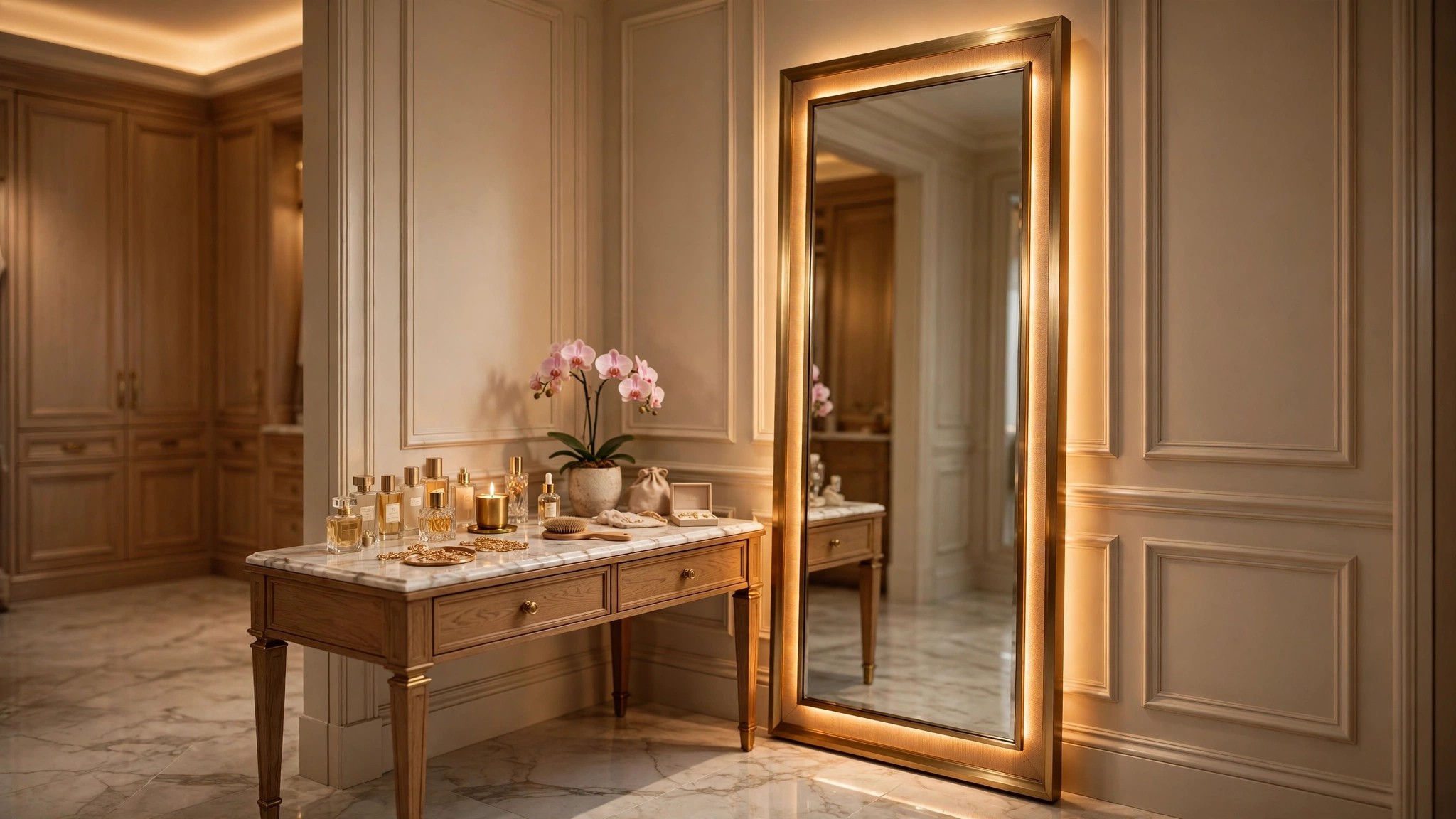
You cannot style what you cannot see. A proper mirror, properly lit, is non-negotiable.
How to do it: Mount the tallest mirror the wall allows — floor to nearly ceiling — in a slim brass or matte-black frame. Flank it with vertical sconces or an LED border at 2700–3000K so light hits evenly from both sides, erasing the harsh shadows a single overhead light creates.
What to avoid: A leaning mirror tucked where the light is worst, or mirrored doors facing a window — glare ruins both the view and the photos.
6. Go Glass-Front on the Wardrobes
Solid doors hide; glass fronts display. Seeing your clothes is what makes a closet feel like a shop you own.
How to do it: Swap solid doors for clear or fluted glass fronts on the sections holding your best pieces — evening wear, handbags, the shoes you love. Interior LED strips make glass cabinets glow like display cases. Keep everyday basics behind solid or fluted fronts so the display stays curated.
What to avoid: Glass everywhere. Display only what you keep tidy — clutter behind glass reads as mess, not boutique.
7. Backlight Your Open Shelving
Floating shelves of folded knitwear and handbags look flat under a ceiling light. Backlighting gives them depth.
How to do it: Run slim LED channels along the back edge of each open shelf, hidden behind a small lip so you see glow, not diodes. Warm 2700K light makes leather and cashmere look rich. Wire the shelves to the same dimmer zone as the room’s accent lighting.
What to avoid: Visible strip dots and uneven runs. Spend a little more on aluminum channels with diffusers — bare strips look DIY in the wrong way.
8. Build a Handbag and Shoe Display Wall
Shoes and bags are the sculpture of a closet. Give them a gallery wall instead of floor piles.
How to do it: Dedicate one wall to angled shoe shelves — heels sit best on slanted displays — plus a few lit cubbies for handbags, each bag stuffed to hold its shape. Arrange by color for visual calm or by frequency of use for practicality; pick one logic and commit to it.
What to avoid: Stacking bags inside each other or lining shoes two-deep. If you cannot see it, you will not wear it — display is organization.
9. Carve Out a Dressing Table Corner
A closet that handles the full getting-ready routine earns its “private boutique” title.
How to do it: Tuck a narrow console or floating desk near the mirror with a comfortable stool, a magnifying mirror, and a tray for daily jewelry. Task lighting matters most here — small shaded lamps or a lit mirror flatter the face for makeup. If the closet adjoins the bedroom, echo that room’s style; our luxury bedroom decor ideas show how to keep the two spaces visually connected.
What to avoid: Letting the dressing table become a landing strip for mail and chargers. One tray for daily essentials; everything else lives in drawers.
10. Line Drawers with Velvet and Divide Everything
Luxury is felt in the details you touch. Velvet-lined drawers make even the small things feel considered.
How to do it: Line jewelry and accessory drawers with velvet inserts or cut-to-fit velvet liner. Add dividers to every drawer — shallow compartments for belts, sunglasses, and watches. Decant loose items into matching trays so nothing rattles around.
What to avoid: Deep, undivided drawers where everything migrates into one tangled layer. A drawer with no dividers is a junk drawer with better lighting.
11. Scent the Space
Boutiques smell like something. Scent is the invisible finish that makes a closet feel intentional.
How to do it: Choose one signature scent — cedar and bergamot, white tea, or soft amber — through drawer sachets, a reed diffuser on the island, or scented drawer liners. Keep it subtle; the closet should greet you, not ambush you. Cedar has the bonus of discouraging moths.
What to avoid: Mixing five fragrances from candles, sprays, and sachets. One scent, layered lightly in two formats at most.
12. Keep One Hero Detail
The difference between a nice closet and a memorable one is a single moment of drama.
How to do it: Pick one: a small chandelier, a vintage rug, an oversized piece of art, a sculptural chair. Let it be the first thing the eye finds and keep everything else quiet around it. This is the detail guests remember — and the one that makes the room feel designed rather than merely organized.
What to avoid: Three hero details competing for attention. One star per room is the oldest rule in decorating because it works.
Frequently Asked Questions
How much does a luxury walk-in closet renovation cost?
A cosmetic refresh — paint, lighting, hardware, and organizers — can land between $2,000 and $8,000 depending on size. Full custom built-ins with glass fronts, an island, and upgraded floors typically run $15,000 to $50,000 or more. Start with lighting and paint; they deliver the most visible change per dollar.
What is the best lighting for a walk-in closet?
Layered, warm light: a central fixture for general glow plus 2700K LED strips inside wardrobes and under shelves, all on dimmers. Avoid cool-white bulbs and single overhead panels — they flatten everything. Mirrors need light from both sides, not just above.
How can I make a small closet feel luxurious?
Small closets go luxe fastest: one enveloping paint color, warm LED strips on every shelf, matching hangers, and a single hero detail like a mini-chandelier or a beautiful rug. Editing is free — a half-empty shelf always looks more expensive than a stuffed one.
What colors make a closet look expensive?
Warm neutrals — ivory, greige, soft taupe, warm white — with one consistent metal finish. Dark, enveloping shades like deep green or charcoal also read expensive in larger closets, especially paired with brass hardware and warm light.
How do I keep a walk-in closet looking boutique-neat?
Give everything a visible home: dividers in every drawer, angled shoe displays, one bag per cubby. Follow a one-in-one-out rule for new purchases and do a five-minute reset each evening — boutiques look perfect because someone tidies them daily.
Sources
- Architectural Digest — closet and dressing-room design features (architecturaldigest.com)
- ELLE Decor — luxury closet tours and organization ideas (elledecor.com)
- House Beautiful — walk-in closet inspiration and small-space ideas (housebeautiful.com)
A luxury walk-in closet is not about owning more — it is about seeing what you own in the best possible light, literally. Start with lighting and a calm palette, add one hero detail, and let the room do what boutiques do: make getting dressed feel like an occasion. To carry the mood through the rest of the house, browse our luxury bedroom ideas and lighting guide.