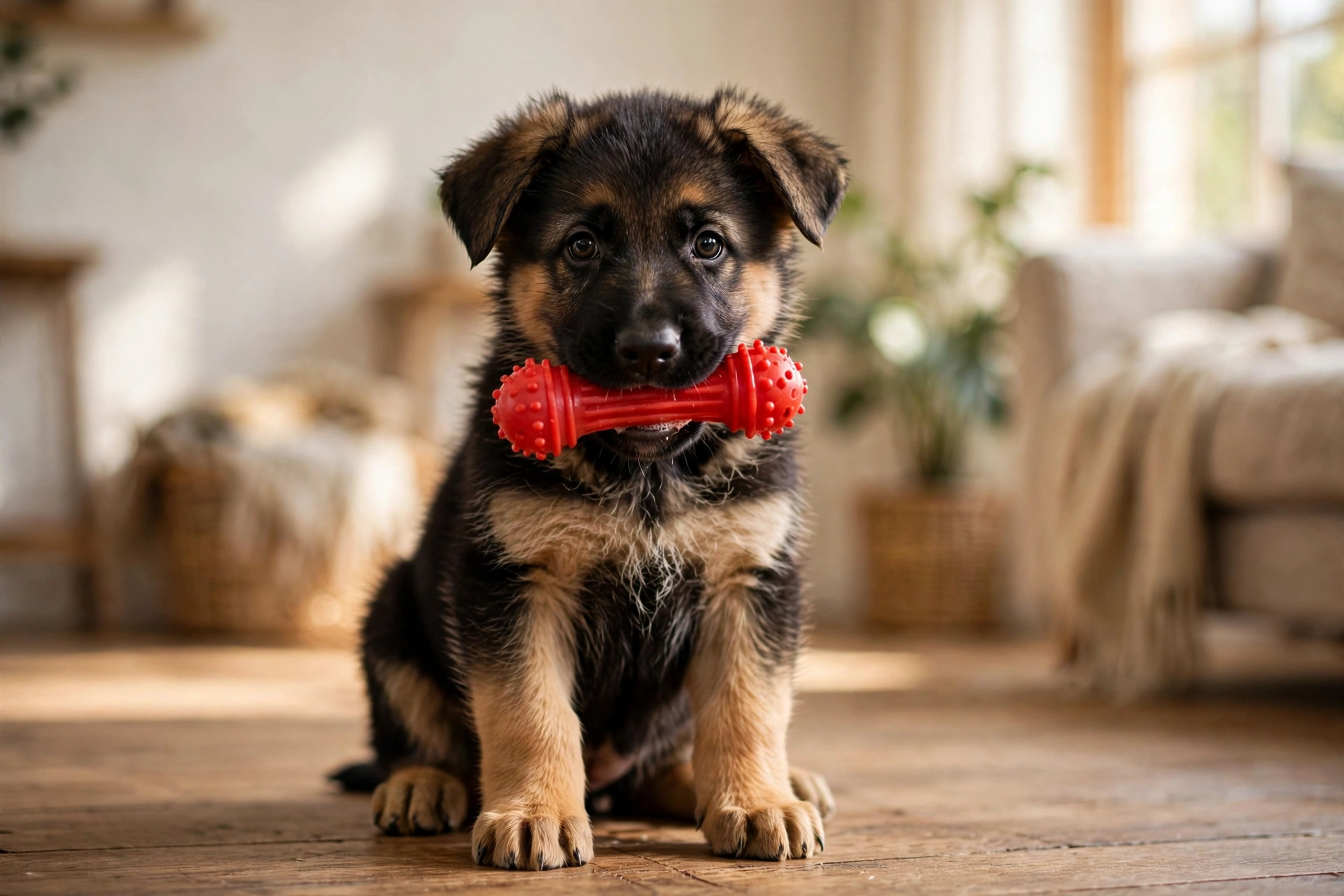
Nobody warns you about this part.
You bring home an eight-week-old German Shepherd puppy — soft ears, clumsy paws, that new-puppy smell — and within forty-eight hours the little angel has turned into a land shark. Ankles, sleeves, fingers, the corner of the couch: everything is a target, and those needle teeth genuinely hurt. If you’re reading this with red marks on your hands, you’re in very good company — almost every German Shepherd owner has been exactly where you are.
Here’s the good news most guides bury: this is normal, it’s temporary, and it’s fixable — but only if you understand why your puppy is doing it and respond the right way.
In this guide I’ll explain why German Shepherd puppies bite so much harder than other breeds, how to tell normal mouthing from real red flags, and the five methods that consistently work — including one popular trick that backfires for a lot of GSD puppies. If German Shepherd puppy biting has taken over your house, you’re dealing with one of the breed’s most common — and most fixable — phases.
Why German Shepherd Puppies Bite More Than Other Breeds
First, the reassurance: your puppy is not aggressive, dominant, or “bad.” German Shepherds are simply mouthier than most breeds, and there are real reasons for it.
They were bred to use their mouths. Herding and grip work is in this breed’s DNA. Where a retriever was bred to carry things gently, a shepherd was bred to grip, hold, and control with its mouth. That instinct shows up at eight weeks old as a puppy who grabs your sleeve instead of just sniffing it.
They’re teething for months. Puppy teeth start falling out around 12–16 weeks, and the adult set isn’t fully in until about 6 months. That’s nearly half a year of sore, itchy gums — and chewing is the only relief they’ve got.
Mouths are how puppies explore. A human baby grabs everything with its hands. A puppy doesn’t have hands, so the mouth does the job: tasting, testing, investigating. Your fingers are just the most interesting objects in the room.
And they’re intense about everything. This is a high-drive, high-energy breed. A Labrador puppy might mouth you lazily; a German Shepherd puppy mouths you like it’s a full-time job. Same behavior, double the intensity.
None of this means you just “wait it out,” though. The biting phase is also the training window — what your puppy learns about using its mouth now shapes the adult dog it becomes.
Normal Mouthing vs. Real Red Flags
Most of what looks scary is completely normal. Here’s how to tell the difference.
Normal — don’t panic:
- Soft mouthing on your hands during play
- Biting that gets worse when the puppy is excited or tired (the infamous evening “witching hour”)
- Grabbing pant legs and sleeves, especially when you walk away
- Mouthing that stops when you redirect to a toy or end the game
Red flags — pay attention:
- A stiff body, hard stare, or growling when you approach their food, toys, or resting spot. That’s resource guarding, and it’s a different problem from play biting — it needs a trainer, not punishment.
- Bites that are hard, deliberate, and unprovoked — not during play, not when excited, just out of nowhere.
- Biting that gets harder and more intense past 6 months despite consistent training.
True aggression in a young puppy is rare. In the vast majority of cases, what looks like aggression in a young puppy is just an over-aroused, overtired baby with sharp teeth. But if you see the red-flag list, don’t try to DIY it — get professional help early. It’s much easier to fix at 4 months than at 14 months.
5 Methods That Actually Stop the Biting
Forget the gimmicks. These five things, done consistently, are what work — roughly in order of impact.
1. Redirect every single time (and keep toys within arm’s reach)
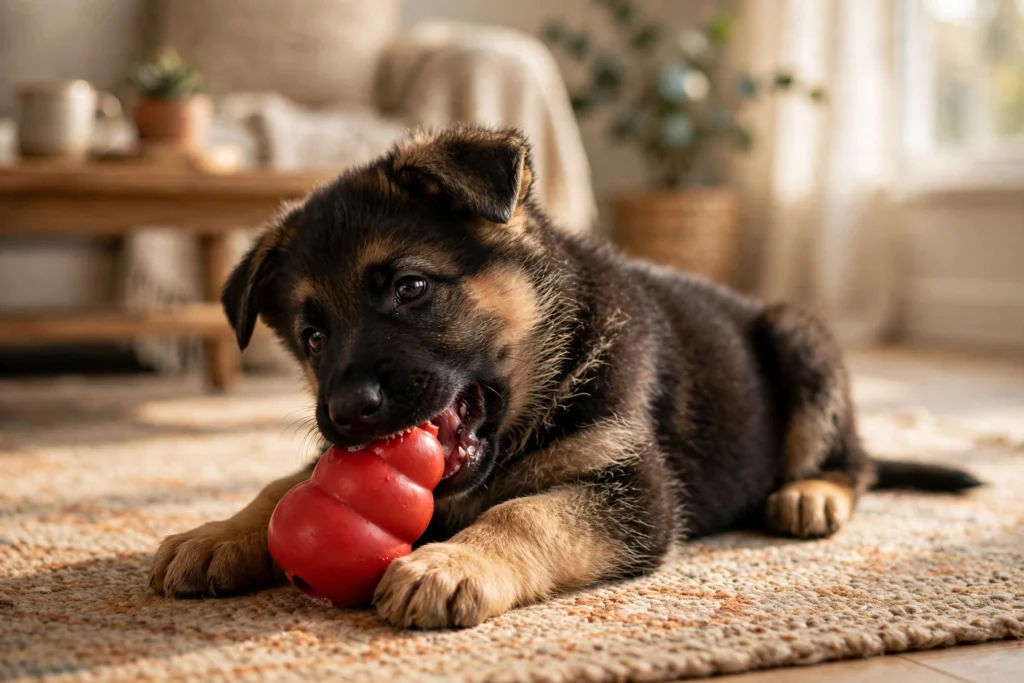
This is the foundation everything else sits on. The moment teeth touch skin, a toy goes into the mouth instead. Not after a lecture, not after saying “no” five times — immediately.
The practical part most guides skip: you need toys everywhere. Keep a cheap rubber toy in every room, one in your pocket on walks, and one by the couch. If you have to walk across the house to find a toy, you’ve already lost — the puppy has moved on to your coffee table leg.
When your puppy takes the toy, praise like they just won a championship. You’re not just stopping the biting; you’re teaching them what to bite. That distinction matters enormously to a dog.
2. Teach bite inhibition with the “ouch and withdraw” method
In the litter, puppies learn how hard is too hard because their siblings yelp and stop playing. You can borrow that lesson: when the puppy bites too hard, say “ouch” in a calm, slightly high-pitched voice — then go completely boring. Turn away, tuck your hands in, end the fun for 20–30 seconds.
Now the honest part: the dramatic yelp that every guide recommends? For a lot of GSD puppies it has the opposite effect — they hear a high-pitched sound and think the game just leveled up. If that’s your dog, skip the theater. A flat, calm “too bad,” followed by you becoming the most boring person alive for half a minute, works better. The message is the same either way: teeth on skin = fun stops.
Three strikes in one session and the puppy goes for a short crate rest. Not as punishment — as a reset.
3. Enforce naps — the overtired puppy is the bitey puppy
Ask experienced owners which single change made the biggest difference, and this is the answer that comes up again and again — yet almost nobody talks about it.
German Shepherd puppies need 18–20 hours of sleep a day. But they won’t choose it themselves — they’ll run on fumes, get cranky, and turn into biting machines. That wild 7 PM “witching hour” where your sweet puppy becomes a demon? That’s not a behavior problem. That’s a tired baby who missed nap time.
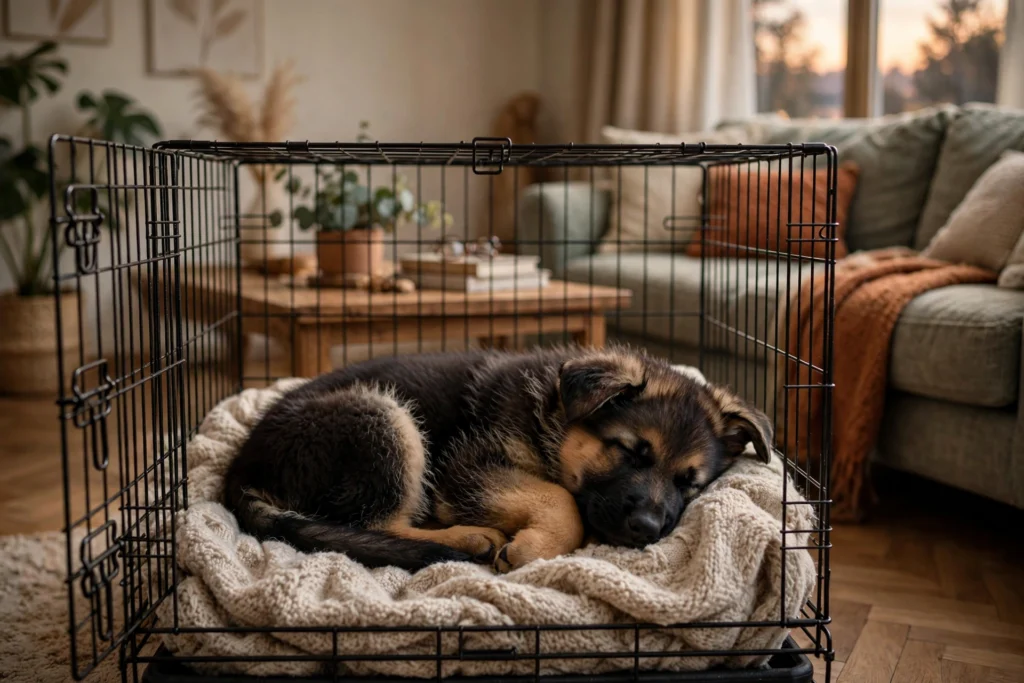
Start putting the puppy down for enforced naps in the crate every 1–2 hours during the day, and most owners see the evening shark attacks drop dramatically within a few days. A simple rhythm — play and train for 45–60 minutes, then crate nap for 1–2 hours — will do more for biting than any training trick.
4. Train “leave it” and “take it gently”
These two cues give you a steering wheel instead of just brakes.
“Leave it” starts boring on purpose: hold a treat in your closed fist, and the instant your puppy backs off or looks away, mark it (“yes!”) and reward from your other hand. Build up slowly to dropped treats, then to exciting things. Within a couple of weeks you can use it mid-play when the puppy goes for your hand.
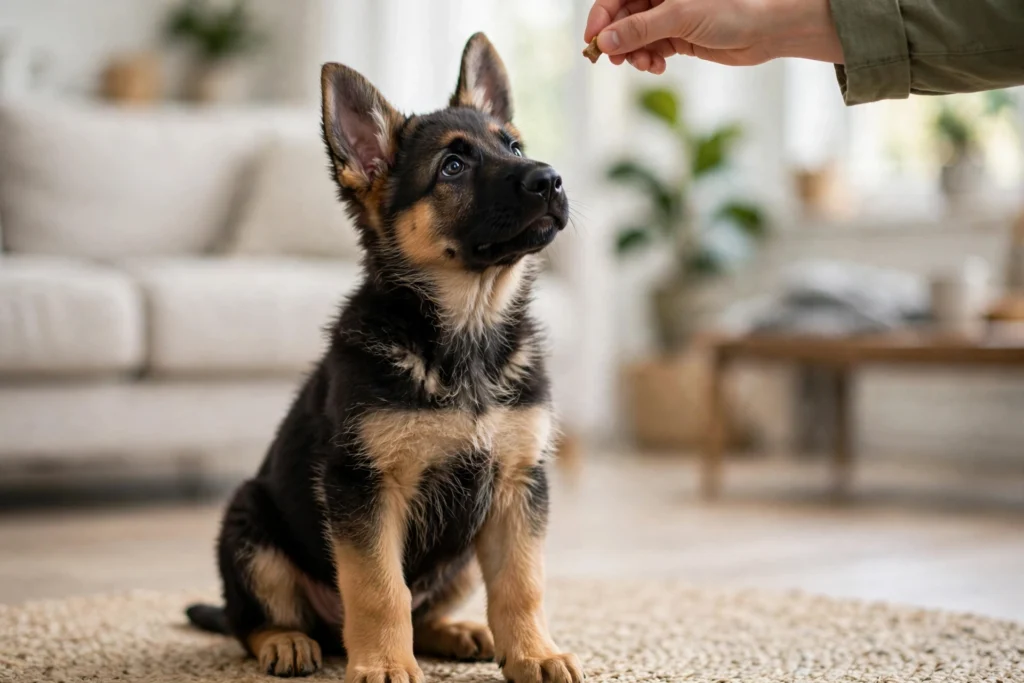
“Take it gently” is for treat time: offer a treat pinched between your fingers, and only release it when the puppy takes it softly. If teeth scrape you, the hand closes and the treat disappears for a few seconds. GSDs are smart — most figure this out within days, and it generalizes to hands surprisingly well.
5. Tire the brain, not just the legs
A bored German Shepherd puppy doesn’t just get sad — it gets creative, and creativity in a teething puppy means destruction and biting.
A common mistake is thinking more walks will fix it. Long walks help, but be careful: too much forced exercise on growing joints can cause real damage (their growth plates don’t close until 12–18 months). Five minutes of sniffing games tires a puppy out more than a 30-minute march anyway.
What actually drains them: scatter a handful of kibble in the grass and let them “hunt” it. Stuff a Kong with peanut butter and freeze it. Do three 5-minute training sessions a day — sit, down, name recognition. Puzzle feeders instead of a bowl. A mentally tired puppy is a calm puppy, and a calm puppy barely bites.
What NOT to Do (These Make It Worse)
The internet is full of old-school advice that will set you back weeks:
- Don’t hit, tap, or flick the nose. It doesn’t teach anything except that hands near the face are scary — with a powerful breed, hand-shyness is the last thing you want.
- Don’t do “alpha rolls” or pin the puppy down. This is outdated, it’s frightening, and with shepherds it often escalates the behavior instead of stopping it.
- Don’t hold the muzzle shut. Same problem — it turns your hands into something to fight, not trust.
- Don’t yell. Yelling is exciting. To a puppy, your dramatic “NO!” is basically you joining the game at a higher energy level.
- Don’t use bitter apple spray as your main plan. Many owners find it doesn’t deter a determined GSD puppy — plenty of them seem to like the taste. Training beats products every time.
The theme here: anything based on fear or pain might suppress the biting for a day, but it damages trust and usually makes the underlying arousal worse. You’re raising a dog that will weigh 75 pounds someday. You want a dog that chooses to be gentle, not one that’s afraid of you.
How Long Until It Stops?
German Shepherd puppy biting usually follows a predictable timeline. Honest answer: the worst of it fades as teething ends, around 6–7 months. With consistent training, most owners see dramatic improvement by 4–5 months — the biting gets softer, less frequent, and easier to redirect.
The variable isn’t the method, it’s the consistency. Doing one technique perfectly for three days and then switching to another is the most common reason people think “nothing works.” Pick the approach above, do it the same way every time, get everyone in the house on the same page, and give it three weeks. Puppies learn fast when the rules don’t change.
When to Call a Professional Trainer
Most biting resolves with the methods above. Get help sooner rather than later if:
- You see resource guarding (stiffening, growling over food, toys, or resting spots)
- The biting is fear-based — cowering, then snapping when cornered
- There’s been zero improvement by 6 months despite consistent work
- Anyone in the house is genuinely afraid of the puppy
Look for a certified trainer who uses positive reinforcement and has experience with shepherds or other high-drive breeds. And one firm rule: anyone who wants to put a shock collar on a 4-month-old puppy is not a trainer you want. Walk away.
Frequently Asked Questions
At what age do German Shepherd puppies stop biting?
Most slow down significantly between 5–6 months as teething ends, and stop almost entirely by 7–8 months with consistent training. Without training, mouthy habits can linger into adolescence.
Is it normal for my GSD puppy to bite my kids?
The behavior is normal, but the situation needs management. Teach kids the house rules: no running and screaming (that’s a chase invitation), no pushing the puppy away with hands (that’s a wrestling invitation), and always let an adult handle the wild moments. Supervise every interaction until the biting phase passes.
Should I yelp when my puppy bites me?
Try it — it works for many puppies. But if your puppy gets more excited by the sound, drop it immediately and switch to the calm withdrawal: flat “too bad,” turn boring for 20–30 seconds. The principle matters, not the specific sound.
Do chew toys actually help with biting?
Yes, especially for teething relief. Frozen carrots, frozen Kongs, and rubber chew toys give sore gums something legal to work on. They’re not a substitute for training, but a puppy with nothing to chew will find something — usually you.
My puppy bites hardest on walks. Why?
Overstimulation. New smells, people, dogs, traffic — it’s a lot for a baby brain. Keep early walks short (5 minutes per month of age is a good rule), bring treats, and don’t be afraid to cut a walk short when the shark mode starts. Calm sniffing in the garden often beats a chaotic neighborhood walk.
Will getting my puppy neutered/spayed stop the biting?
No. Biting is a developmental and training issue, not a hormonal one. Spay/neuter decisions should be made with your vet based on health timing, not behavior hopes.
Sources
American Kennel Club — “How to Stop Puppy Biting”: https://www.akc.org/expert-advice/training/stop-puppy-biting/
American Kennel Club — “Puppy Teething and Nipping: A Survival Guide”: https://www.akc.org/expert-advice/puppy/puppy-teething-and-nipping/
American Kennel Club — “Puppy Nipping: How to Stop a Puppy From Biting”: https://www.akc.org/expert-advice/training/puppy-stop-nipping
This article is for informational purposes only and is not a substitute for professional veterinary or behavioral advice. If your puppy’s biting concerns you, consult your veterinarian or a certified professional dog trainer.