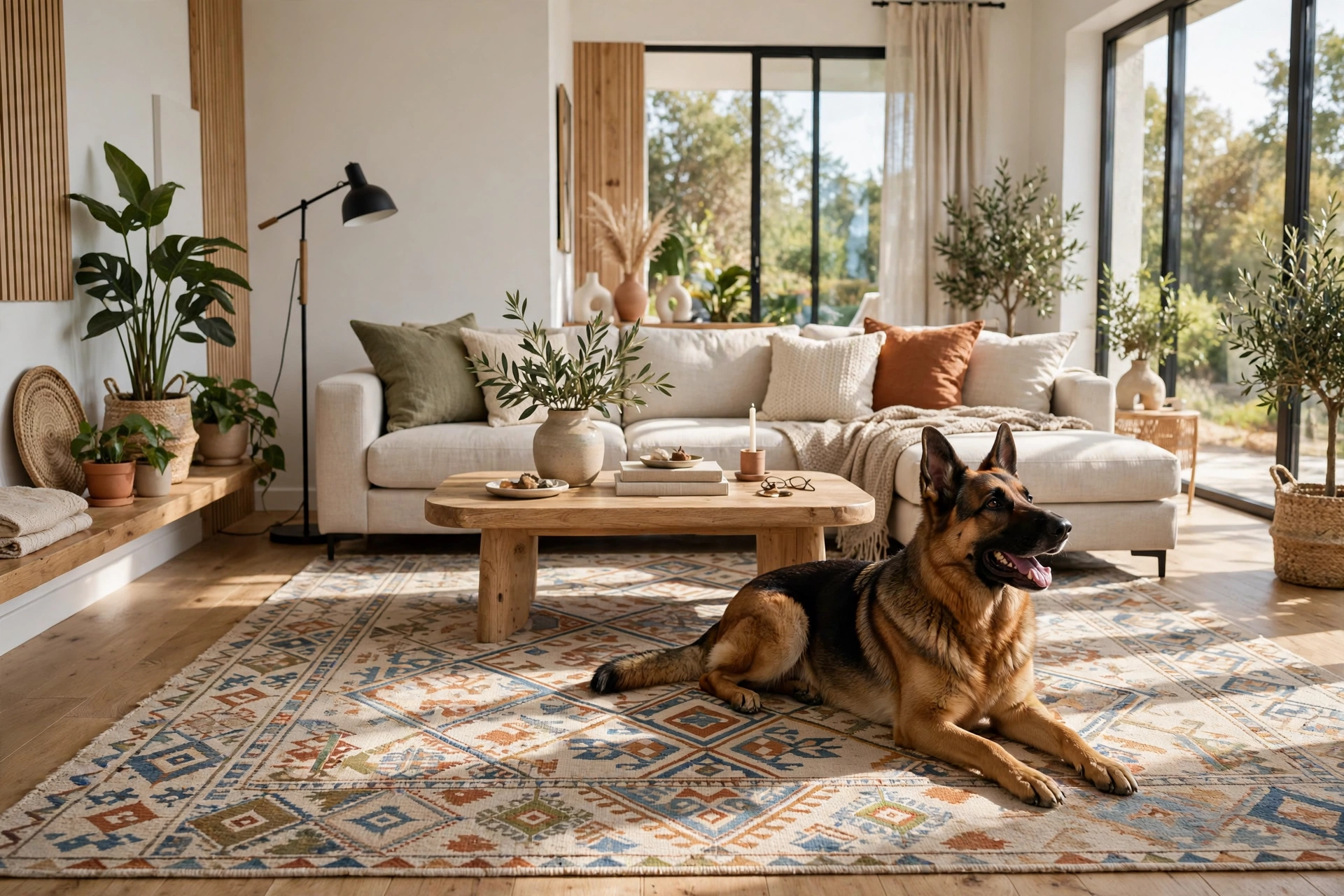
A rug in a dog home has two jobs: look good and survive. Traditional rugs fail the second job the first time muddy paws cross them — professional cleaning is expensive, and by the third accident most people just roll the rug up and live with bare floors.
Washable rugs change the equation. When the worst happens, the fix is a washing machine, not a phone call. But not all washable rugs are equal, and marketing claims do not always survive contact with a 40-kilo dog. This guide covers the 10 best types of washable rugs for dog homes, what to look for in each, and how to size and place them so they actually last.
What to look for before you buy
A quick buyer’s checklist that applies to every type below:
- Low pile height (under 0.5 inch). Short fibers do not trap fur and grit deep down, they dry faster after washing, and they fit in a home washing machine.
- Truly machine-washable construction. “Spot clean only” is not washable. Check the care label: cold water, gentle cycle, and air-dry or tumble-dry-low are what you want.
- Non-slip backing that survives washing. TPE or natural rubber backing grips hard floors and holds up through repeated wash cycles. Cheap latex backing crumbles after a few washes.
- Stain-resistant fibers. Solution-dyed polyester and nylon resist stains at the fiber level rather than relying on a topical coating that washes off.
- The right size for the space. A rug that is too small slides around and curls at the edges — both trip hazards for an excitable dog. Size up, not down.
For deeper background on rug construction and backing types, see the Carpet and Rug Institute.
1. Low-pile machine-washable area rugs
The workhorse of the dog-friendly home. These are full-size area rugs — 5×7, 8×10, even 9×12 — designed to go straight into a home washing machine (front-loaders handle the larger sizes best).
Best for: Living rooms and bedrooms where the dog spends most of its time.
Look for: Polyester or nylon face fibers, TPE backing, and a care label that explicitly says machine washable — not “easy to clean.”
2. Two-piece washable rug systems
These pair a thin, lightweight printed top layer with a separate thick non-slip pad underneath. To wash, you peel off the top layer — which weighs a fraction of a normal rug — and toss just that in the machine. The pad stays on the floor.
Best for: Large living rooms where a one-piece 8×10 would never fit in a washer.
Look for: A top layer that attaches securely (no bunching underfoot) and a pad thick enough to feel like a real rug, around 0.25–0.4 inch.
3. Cotton flatweave rugs
Cotton dhurries and flatweaves have been washed for centuries — they predate the “washable rug” marketing category entirely. They are thin, light, fully machine-washable, and dry quickly.
Best for: Kitchens, laundry rooms, and low-traffic spots where you want something washable and inexpensive enough to replace every couple of years.
Look for: Tight weaves in medium or dark tones. Note that cotton absorbs liquid fast, so these are better for fur and dust than for accident-prone zones — blot spills immediately.
4. Indoor/outdoor rugs
Made from polypropylene, indoor/outdoor rugs are essentially waterproof: mud, water bowl splashes, and drool sit on the surface instead of soaking in. Many can be hosed down outside as well as machine-washed.
Best for: Entryways, mudrooms, and covered patios — anywhere wet paws land first.
Look for: A soft-touch polypropylene rather than the stiff, plasticky kind. Texture quality varies enormously at the same price point.
5. Waterproof-backed rugs
These have an impermeable membrane between the face fibers and the backing, so liquid never reaches your floor. The surface still needs cleaning, but one accident does not become a floor-refinishing project.
Best for: Homes with senior dogs, puppies in training, or any dog with occasional accidents.
Look for: A membrane that does not crinkle or make noise underfoot — cheaper versions feel like walking on a shower curtain. Wash on gentle; high heat degrades waterproof layers.
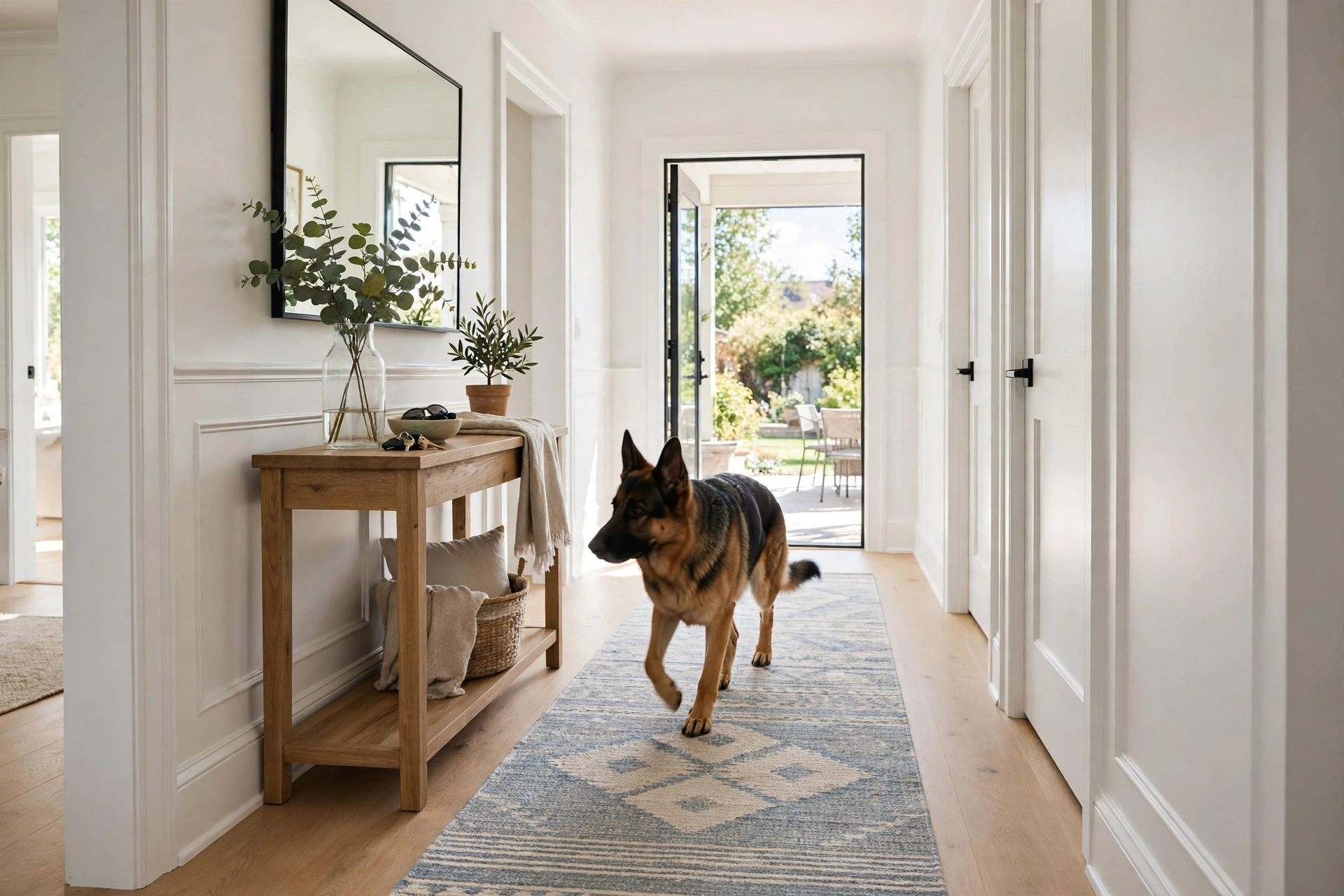
6. Washable runner rugs
Hallways and entry paths are where dogs do their highest-speed, muddiest traveling. A washable runner along the main dog highway protects floors exactly where they need it.
Best for: Hallways, entry corridors, and the path from the back door to the living room.
Look for: Runners at least 2.5 feet wide (narrower ones slide and bunch), with serious non-slip backing — runners take lateral force from turning dogs that area rugs never see.
7. Vintage-look washable rugs
Persian and vintage-style patterns in faded, muted tones are the most forgiving designs in existence for dog homes. Fur, faint stains, and general wear disappear into the pattern.
Best for: Living rooms and dining rooms where you want the rug to look like a design choice, not a compromise.
Look for: The same construction standards as any washable rug — pattern does not compensate for bad backing. Muted reds, blues, and greiges hide the most. For a cohesive palette, pair your rug with one of these living room color schemes.
8. Round washable rugs
Round rugs suit the spots dogs actually circle: in front of a favorite armchair, beside the bed, or under a crate. They are also among the easiest shapes to fit in a washing machine.
Best for: Accent spots, crate areas, and small bedrooms.
Look for: 4–6 foot diameters for real usability. Smaller “decorative” rounds slide around under paws and become toys.
9. Stain-resistant polyester rugs with attached non-slip backing
This is the mainstream category most “washable rug” marketing describes: a soft polyester face permanently bonded to a non-slip base. No separate pad to align, nothing to peel apart.
Best for: Anyone who wants the simplest possible setup — unroll and forget.
Look for: Solution-dyed polyester (stain resistance built into the fiber, not sprayed on) and backing that is part of the rug rather than glued on — glued layers delaminate with repeated washing.
10. Budget-friendly washable rugs for high-destruction zones
Puppy chewing phase? A dog that digs at rugs before lying down? Sometimes the smart buy is a rug you will not mourn. Inexpensive machine-washable rugs in the smallest size that works can be treated as semi-disposable while the destructive phase passes.
Best for: Puppy zones, foster homes, and anywhere a rug’s life expectancy is measured in months.
Look for: Even at low prices, insist on machine-washable and non-slip. A cheap rug that slides under a running dog is a vet bill waiting to happen.
Sizing tips for homes with dogs
Getting the size right matters more with dogs than without:
- Living room: All four legs of the sofa on the rug, or at minimum the front legs. For most sofas this means 8×10, not 5×7. An undersized rug bunches when a dog launches off the couch.
- Bedroom: Extend at least 18 inches beyond each side of the bed so the dog’s morning stretch happens on rug, not cold floor.
- Hallways: Leave 4–6 inches of bare floor visible on each side; wall-to-wall runners look cramped and trap dust at the edges.
- Dining area: The rug should extend 24 inches past the table on all sides so chair legs — and the dog waiting underneath — stay on the rug when chairs move.
When in doubt, go one size up. Dogs use the edges of rugs as launchpads; a rug with generous margins stays put.
What to avoid
- High-pile shag rugs. Fur weaves into the base where no vacuum reaches, and most cannot be machine-washed at all.
- Jute, sisal, and other natural-fiber rugs. They absorb moisture and odor permanently, stain on contact with anything wet, and unravel under digging claws.
- Rugs with glued-on latex backing. The latex crumbles after a few wash cycles, leaving black flakes across your floor.
- “Spot clean only” rugs marketed as pet-friendly. If you cannot wash it, it is not a dog rug — it is a countdown.
- Light solid colors in high-traffic dog paths. Even washable, they will look dingy between washes. Patterns earn their keep here.
FAQs
How often should I wash a rug if I have a dog?
For a rug in the dog’s main living area, a full machine wash every 4–8 weeks is a realistic baseline, with vacuuming 2–3 times a week in between. Entryway runners that catch muddy paws may need washing monthly. Wash immediately after any accident — enzyme-based pre-treatment first, then the machine.
Do washable rugs slip on hard floors?
Quality ones do not. Look for TPE or natural rubber backing, which grips through many wash cycles. Avoid rugs that rely on a separate thin pad you must align yourself unless it is a proper two-piece system. On very slippery floors, a rug pad underneath adds insurance regardless of the rug’s own backing.
Can washable rugs go in the dryer?
Usually on low heat or air-fluff, but check the care label — high heat degrades waterproof membranes and can melt synthetic backings. Air-drying flat is the safest universal method and extends the rug’s life noticeably. Never wring a washable rug; press out water and dry it flat.
What size rug is best for a living room with a dog?
8×10 feet suits most standard living rooms and keeps the rug stable when dogs run and turn on it. The front legs of all main seating should sit on the rug. Smaller rugs slide, curl at the corners, and become trip hazards — with dogs, bigger is almost always better.
Will a washable rug survive muddy paws?
That is exactly what it is for. Let mud dry completely, then vacuum — dried mud releases from low-pile synthetic fibers easily. For wet mud, blot first, then machine-wash. Indoor/outdoor polypropylene rugs and waterproof-backed rugs handle the wettest paws with the least fuss.
Sources
- Carpet and Rug Institute — rug construction, backing types, and cleaning guidance: https://carpet-rug.org/
- American Kennel Club — dog care and home setup advice: https://www.akc.org/expert-advice/