Most dog crates look like they belong in a kennel, not a living room. But a crate does not have to be an eyesore — these stylish dog crate ideas turn a basic wire box into a piece of furniture you would have bought anyway. The trick is to stop treating the crate as dog equipment and start treating it as furniture that happens to hold a dog: match the finish to your room, give the crate a second job, and style around it like anything else in the house.
One rule before the ideas: style should never come at the cost of the dog’s comfort. Every option below assumes a correctly sized, well-ventilated crate introduced with patient, positive training.
Stylish dog crate ideas: 10 ways to make a crate look like furniture
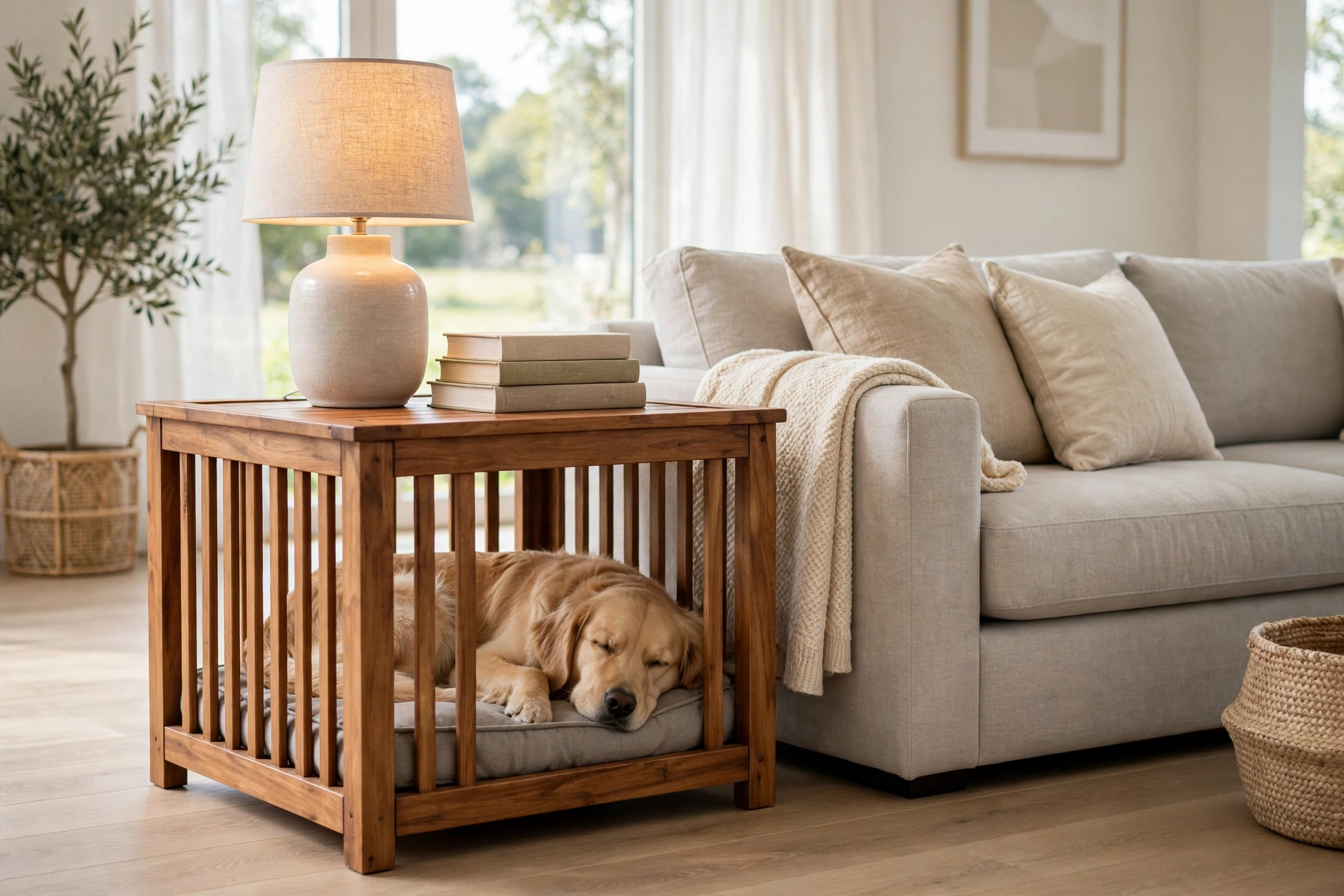
1. Choose a crate that doubles as an end table

Furniture-style crates with solid tops sit beside the sofa at arm height and hold a lamp, a coaster, and the remote — nobody guesses there is a dog inside until the dog walks out.
How to do it: Measure your sofa arm height and match the crate top to within an inch or two. Anchor the crate so it cannot shift when the dog moves, and style the top lightly — a lamp and a small tray is plenty.
What to avoid: Thin tops that bow under weight, and bar spacing wide enough for a small dog to push its head through.
2. Try an enclosed wooden crate cabinet

These look like a credenza, with slatted sides for airflow and a solid top you can decorate. From across the room, it reads as furniture, full stop.
How to do it: Choose slatted sides over decorative cutouts — dogs need real cross-ventilation. Match the wood tone to your existing furniture and check that the latch is secure enough that a determined dog cannot nose it open.
What to avoid: Fully enclosed boxes with tiny vent holes, which trap heat, and cheap laminate finishes that claws scratch through in months.
3. Build the crate into existing cabinetry
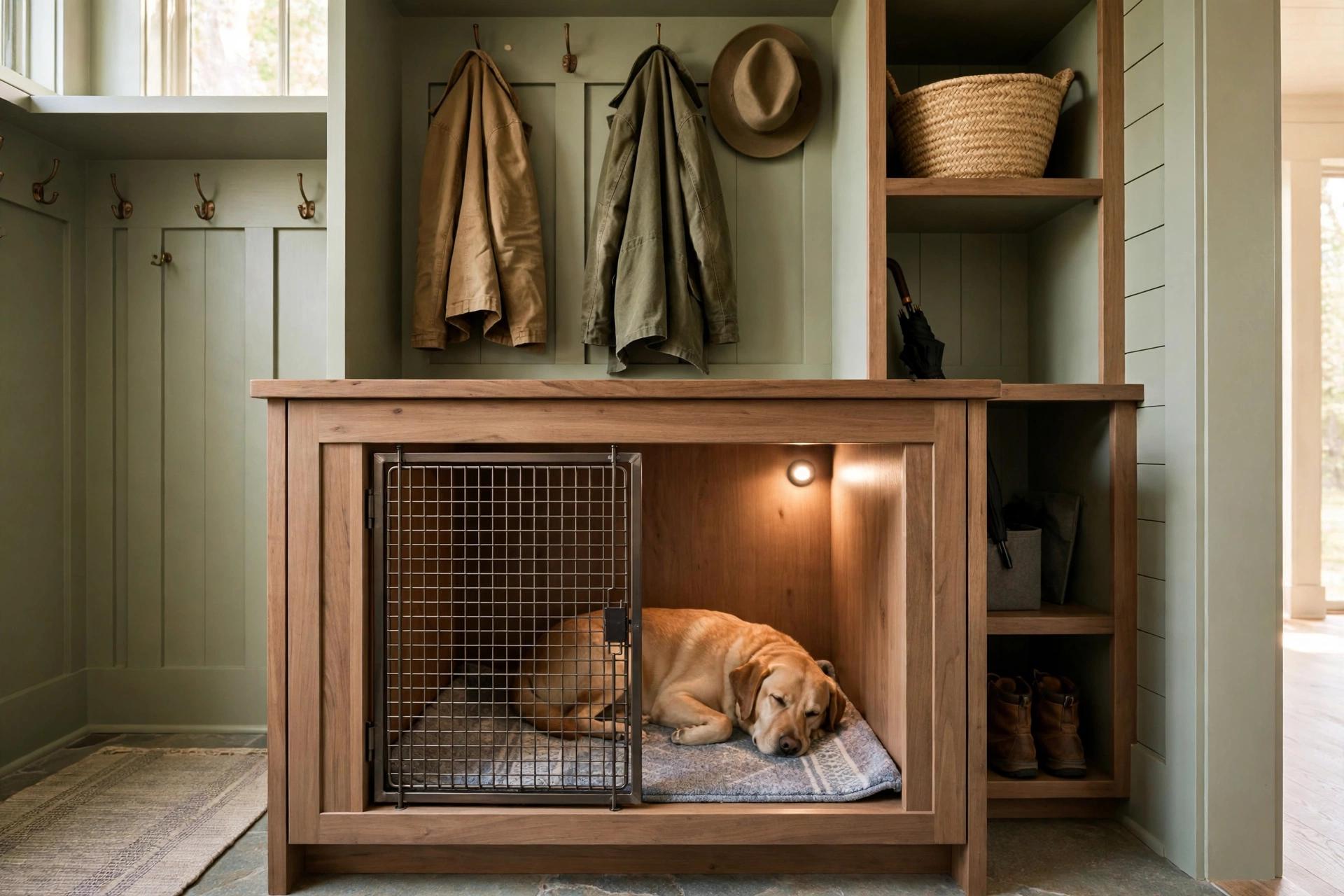
A dead cabinet in a mudroom, laundry room, or kitchen island can become a built-in crate nook — the most invisible option of all, since the crate disappears into the architecture.
How to do it: Remove the cabinet door and replace it with a framed wire or slatted panel. Line the floor with a washable, waterproof mat, keep the opening tall enough for the dog to stand and turn, and add a small puck light so it is not a dark cave.
What to avoid: Cabinets beside heat sources like dryer vents, and solid doors that seal the front — a closed cabinet becomes an oven in summer.
4. Use a tailored crate cover
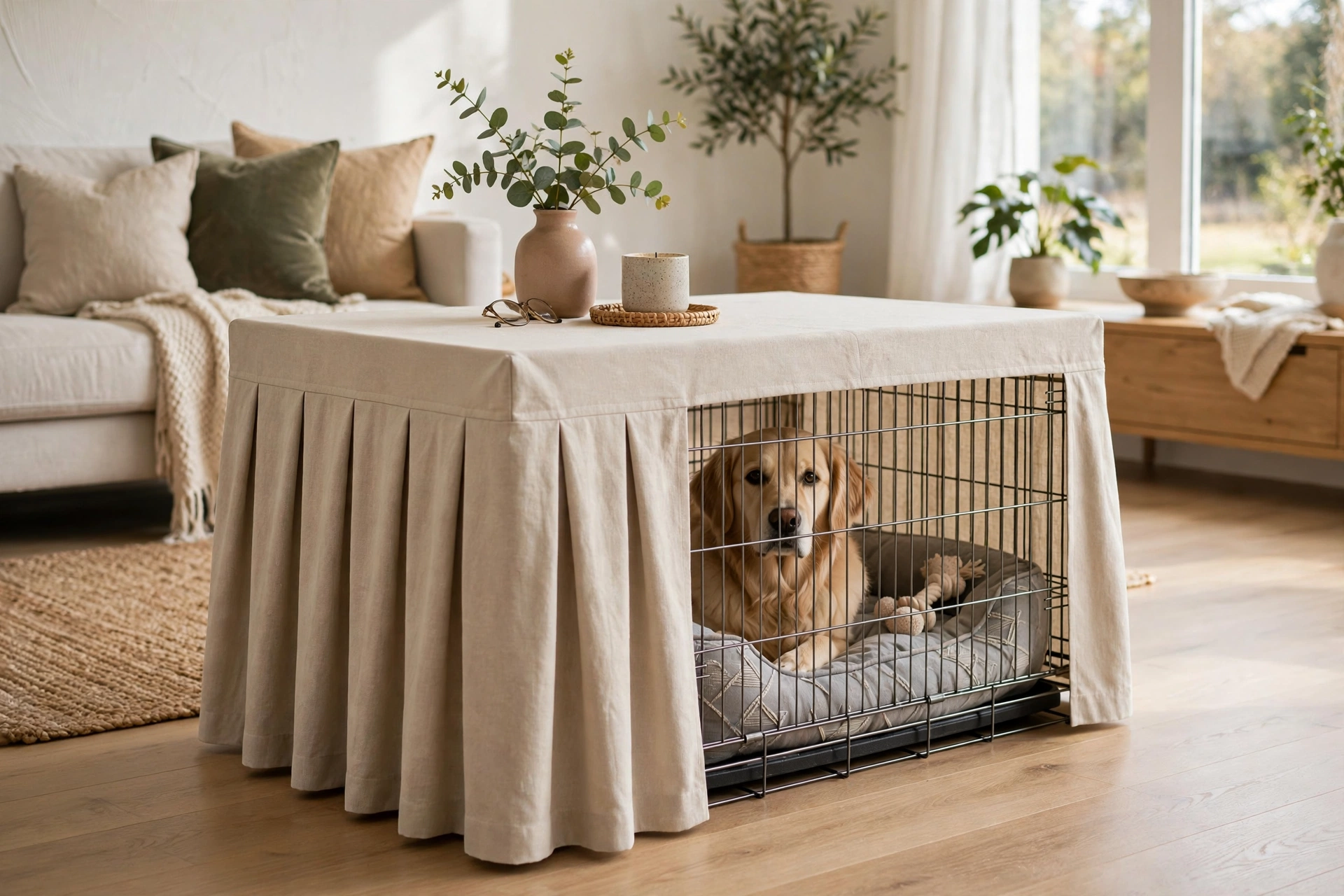
A well-fitted cover turns a standard wire crate into a skirted side table. It is the budget option, and it works with the crate you already own.
How to do it: Measure your exact crate model and buy a cover made for those dimensions, in a washable fabric that coordinates with your room. Leave the door end open or use a cover with a roll-up flap so the entrance stays inviting.
What to avoid: Heavy blankets draped over the top — they block airflow, trap heat, and slide off. Also skip dark, heavy fabrics in small rooms; they make the crate look bulkier, not smaller.
5. Turn the crate into a console table behind the sofa

A long, low crate behind the sofa works like a console table: a surface for a tray and a lamp, with the dog’s den hidden in dead space most living rooms waste anyway.
How to do it: Use a furniture-style crate at least half your sofa’s length. Style the top with a tray to corral small items, and face one end toward the room so the dog can see the family — dogs settle far better when they can see their people.
What to avoid: Lightweight crates that slide when the dog launches out, and overloading the top with heavy objects that become projectiles if bumped.
6. Create a crate nook under the stairs

Under-stair space is awkward for furniture and perfect for a dog den. It uses square footage you were not using and keeps the crate out of the room’s main sightlines.
How to do it: Measure carefully — the dog must stand fully upright and turn around at the tallest point. Add a washable mat, a little lighting, and keep it away from the front door if your dog is noise-sensitive.
What to avoid: Dark, damp, or unventilated spots, and the noisy entryway if your dog barks at visitors. A crate should feel like a retreat, not a guard post.
7. Pick a crate finish that matches your furniture

Sometimes the only problem is color. A chrome crate in a warm wood-toned room draws the eye; the same crate in matte black in a modern black-and-oak room nearly vanishes. Wire crates now come in black, white, bronze, and wood-look finishes.
How to do it: Name the dominant metal and wood tones in the room, then match the crate to one of them. Black suits modern rooms, white suits coastal and Scandinavian spaces, bronze blends with traditional wood furniture.
What to avoid: Mixing three or four finishes in one corner. One crate, one finish, matched to something already in the room.
8. Style the top of the crate like a sideboard

Any flat-topped crate can be styled: a tray, a stack of books, a small non-toxic plant — suddenly the crate is a styled surface that happens to have a dog underneath.
How to do it: Use a tray to keep items from migrating to the edge, and keep styling low and stable. Rotate seasonal touches the way you would on any sideboard.
What to avoid: Candles, heavy sculptures, and anything toxic within reach. Dogs bump crates — assume anything on top will eventually meet the floor.
9. Frame the crate zone with a decorative divider

A folding screen or freestanding divider can frame the crate into a deliberate-looking “dog zone” instead of a crate shoved against the wall, adding texture while giving the dog a sense of enclosure.
How to do it: Choose a sturdy freestanding screen — rattan, wood slat, or upholstered panels — angled to partially screen the crate without blocking the door or airflow. Leave clearance so the crate door opens fully.
What to avoid: Flimsy screens a large dog can knock over, and placing the divider so close it traps the door shut.
10. Go rustic with a barn-door style crate
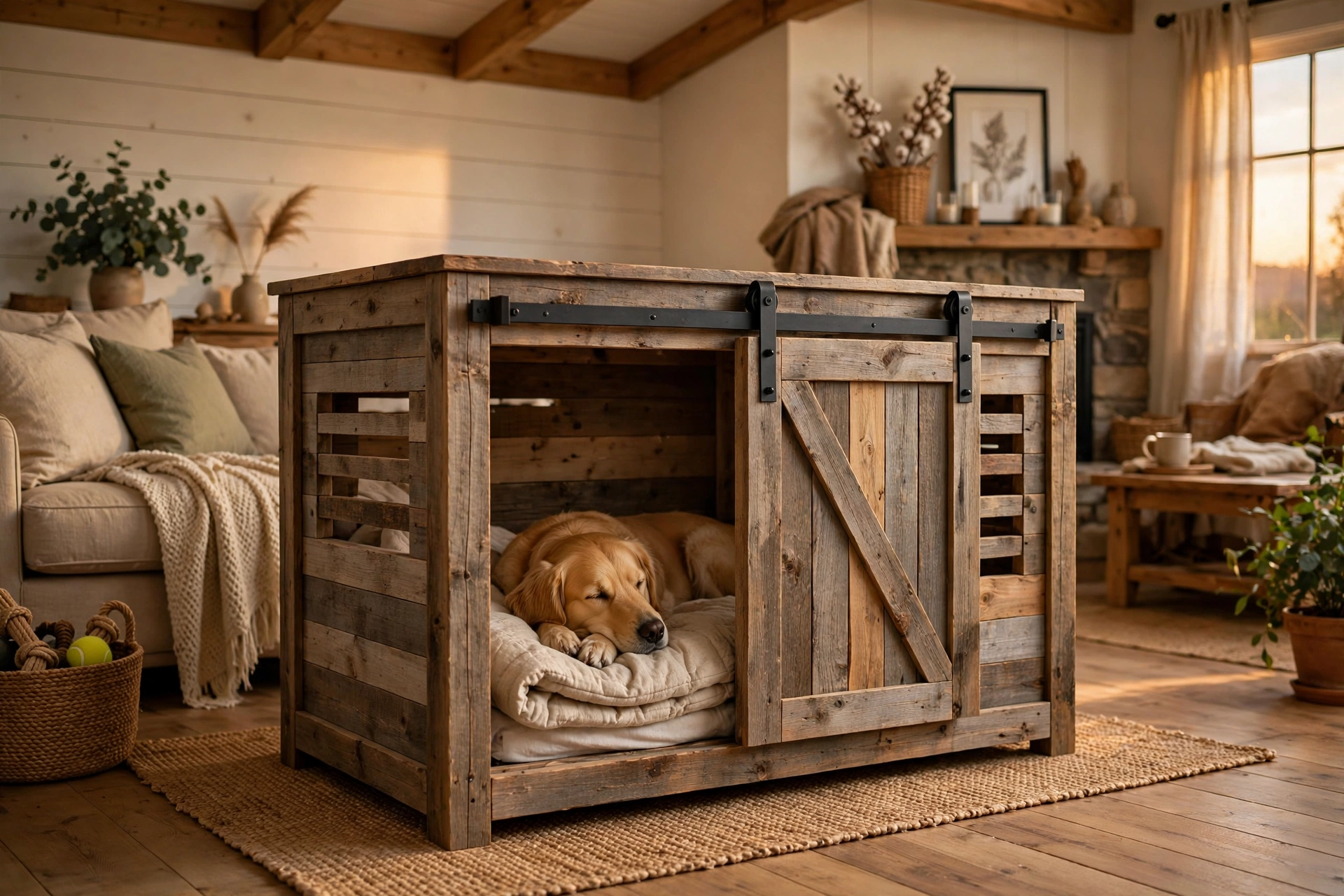
For farmhouse or cabin-style rooms, a wooden crate with a sliding barn door looks intentional in a way wire never will — and there is no squeaky latch at midnight.
How to do it: Look for smooth-sliding hardware and a door that latches positively closed. Sand and seal any rough wood, and stain it to match your other rustic pieces.
What to avoid: Unfinished wood with splinters, and sliding doors with gaps a clever dog can nose open.
Crate sizing: get the fit right first
No styling trick fixes a wrong-sized crate. The standard guidance: the dog should stand up fully, turn around easily, and lie down stretched out. For housetraining a puppy, the space should be just big enough for that — extra room invites the puppy to sleep in one corner and soil the other, which is why many crates include a divider panel.
Measure shoulder height and nose-to-tail-base length while the dog stands, then add a few inches of clearance each way. Between two sizes, size up — a slightly roomy crate beats a cramped one.
Crate training basics that make the crate welcome
A beautiful crate still needs a dog who likes being in it. The widely recommended approach:
- Introduce gradually. Leave the door open and let the dog explore for the first few days. Toss treats inside; never force the dog in.
- Feed meals inside. Mealtimes in the crate build a fast positive association.
- Build duration slowly. Start with minutes, not hours, and increase as the dog relaxes.
- Never use the crate as punishment. The moment the crate means trouble, training goes backward.
- Keep absences reasonable. Young puppies manage only a few hours; adult dogs should not be crated all day without a midday break.
If the dog panics, drools excessively, or tries to break out, stop and consult a trainer or your vet.
What to avoid with dog crates
- Crates as all-day storage. A crate is a den and a training tool, not a 10-hour parking spot.
- Wire crates with sharp weld points or flimsy latches. Run your hand over every edge before the dog goes in.
- Bedding a chewer can shred and swallow. Use a durable crate mat — or nothing — until the chewing phase passes.
- Direct sun or cold drafts. Temperature swings make the crate miserable; pick a spot with stable conditions.
- Guessing the size. Measure the dog; do not eyeball it.
- Over-decorating the inside. Bedding, water for longer stays, one safe chew. The styling belongs outside the crate.
FAQs
What size crate does my dog need?
The dog should stand fully upright, turn around comfortably, and lie stretched out. Measure shoulder height and nose-to-tail-base length while standing, then add a few inches each way. For housetraining puppies, use the divider panel to keep the space snug and expand it as the puppy grows.
Are furniture-style dog crates safe?
Well-made ones are. Look for solid construction, ventilation on multiple sides (not just the front), a secure latch, and bar spacing suited to your dog’s size. Avoid fully enclosed designs with minimal airflow and cheap laminate a dog can chew through.
How long can a dog stay in a crate?
Young puppies manage only a few hours; healthy adults handle longer stretches but should not be crated a full workday without a break. If you are away long hours, a larger confinement area or a midday dog walker is kinder than a crate.
Should I cover my dog’s crate at night?
Many dogs settle better with a breathable, properly fitted cover — but always leave the door end ventilated. If the dog pants or paces, remove the cover. Never use heavy blankets that block airflow.
Can I use a dog crate as a side table?
Yes — that is what furniture-style crates and tailored covers are for. Keep the top lightly styled, anchor the crate so it cannot shift, and make sure nothing on top can fall on the dog if bumped.
Sources
- American Kennel Club — crate training guidance
- ASPCA — general pet care resources