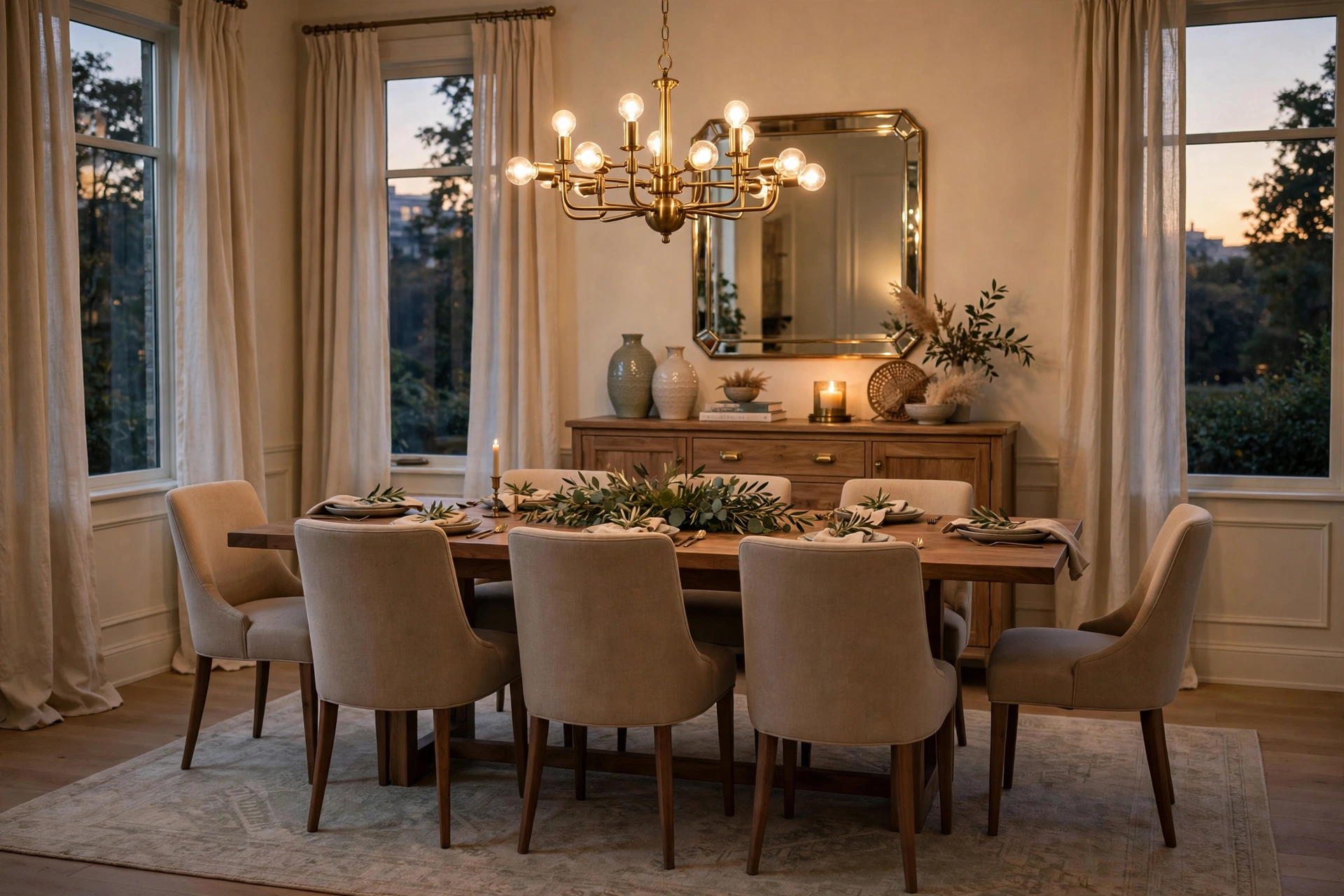
A dining room is where a home slows down — shared meals, long conversations, holiday dinners. Yet it is also one of the rooms people decorate last, leaving a bare table under a lonely ceiling fixture for years. The good news is that great dining room decor ideas are mostly about a few correct decisions rather than a big budget. The twelve ideas below cover sizing, lighting, and styling with exact how-to detail, plus what to avoid for each one.
1. Measure First: The Smartest of All Dining Room Decor Ideas
Every expensive dining room mistake — a table that blocks the doorway, chairs that cannot pull out — comes from skipping measurements. Before you buy or rearrange anything, measure the room, the table, and the clearance around it. This one habit separates rooms that look designed from rooms that look accidental.
How to do it: Allow at least 36 inches between the table edge and any wall or furniture so chairs pull out and people walk behind seated diners; 44–48 inches is better if the walkway serves as a main path. Budget about 24 inches of table width per diner. The National Association of Home Builders publishes space-planning guidance built around these same clearances, and they hold up in real homes.
What to avoid: Avoid buying the table first and hoping the room cooperates — the most common regret in dining rooms. Do not forget door swings: a sideboard looks perfect on paper until a swinging door hits it.
2. Hang a Statement Chandelier or Pendant at the Right Height
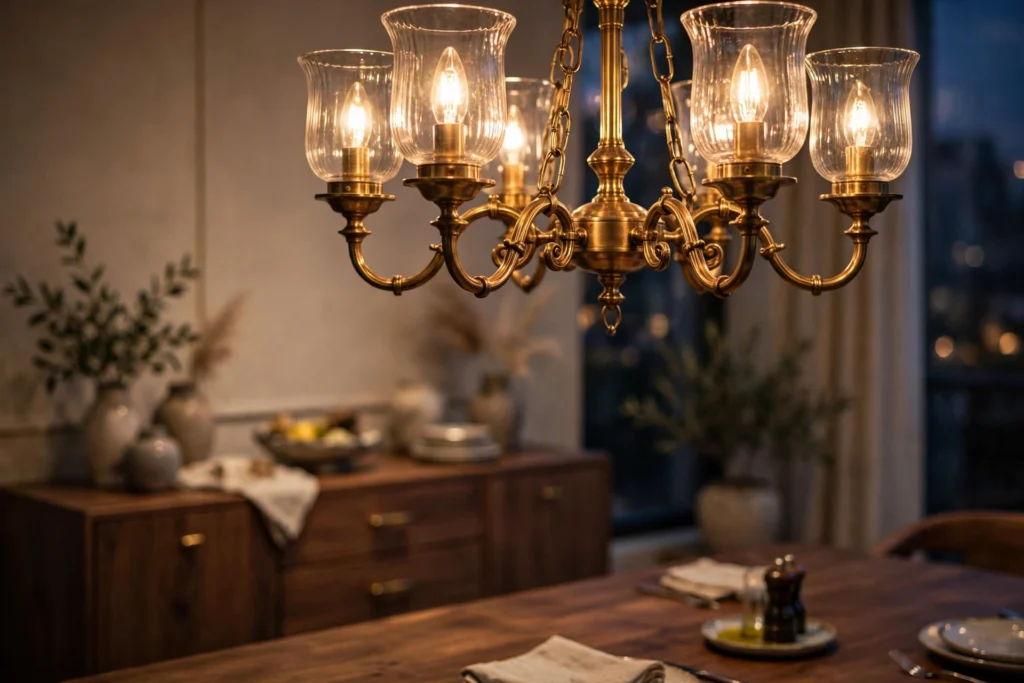
One well-chosen fixture over the table does more for a dining room than almost any other single change. It anchors the table visually, sets the mood for evening meals, and gives the room a focal point from every doorway.
How to do it: Hang the bottom of the fixture 30–34 inches above the tabletop (slightly higher for ceilings over 9 feet). Size the fixture to roughly one-half to two-thirds the table width. Use warm-white bulbs (2700–3000K) on a dimmer so the same light works for homework, dinner parties, and quiet breakfasts. Where possible choose ENERGY STAR certified fixtures to keep energy use low without sacrificing warmth.
What to avoid: Avoid hanging the fixture so high it floats disconnected from the table, or so low guests see bulbs at eye level. Do not use cool daylight bulbs — they make food and faces look harsh.
3. Match the Table Shape to the Room’s Shape
Table shape is a layout decision, not just a style preference. The right shape improves traffic flow and seating comfort; the wrong one wastes space and creates awkward corners nobody can use.
How to do it: Use a round or square table in square rooms and tight spaces — no corners means easier movement and better conversation. Use a rectangular table in long, narrow rooms. A 72-inch rectangular table seats six comfortably; extendable tables are the practical answer when daily seating is four but holidays need ten.
What to avoid: Avoid a round table in a long narrow room — it leaves dead space at both ends. Do not choose glass if you hate visible fingerprints, and skip sharp-cornered tables in homes with small children.
4. Choose Dining Chairs Built for Long, Comfortable Sits
Dining chairs are sat in longer than most people plan for — dinners stretch, guests linger. Comfortable chairs with a bit of padding get used; stiff, pretty ones send everyone to the sofa.
How to do it: Look for upholstered or softly padded seats, a seat height around 18 inches, and a back with at least a slight recline or lumbar curve. Mixing two chair styles — for example, upholstered host chairs at the ends and simpler side chairs — adds designer character. Keep seat widths around 20–22 inches so chairs fit the table without crowding.
What to avoid: Avoid chairs that are beautiful but painful after twenty minutes — test-sit before committing. Do not mix more than two styles, and skip chair arms on side chairs in tight rooms; they need extra inches to slide in.
5. Style a Centerpiece That Does Not Block Conversation
A centerpiece should be seen across, not peered around. The classic mistake is a tall arrangement that turns dinner into a game of hide-and-seek between guests.
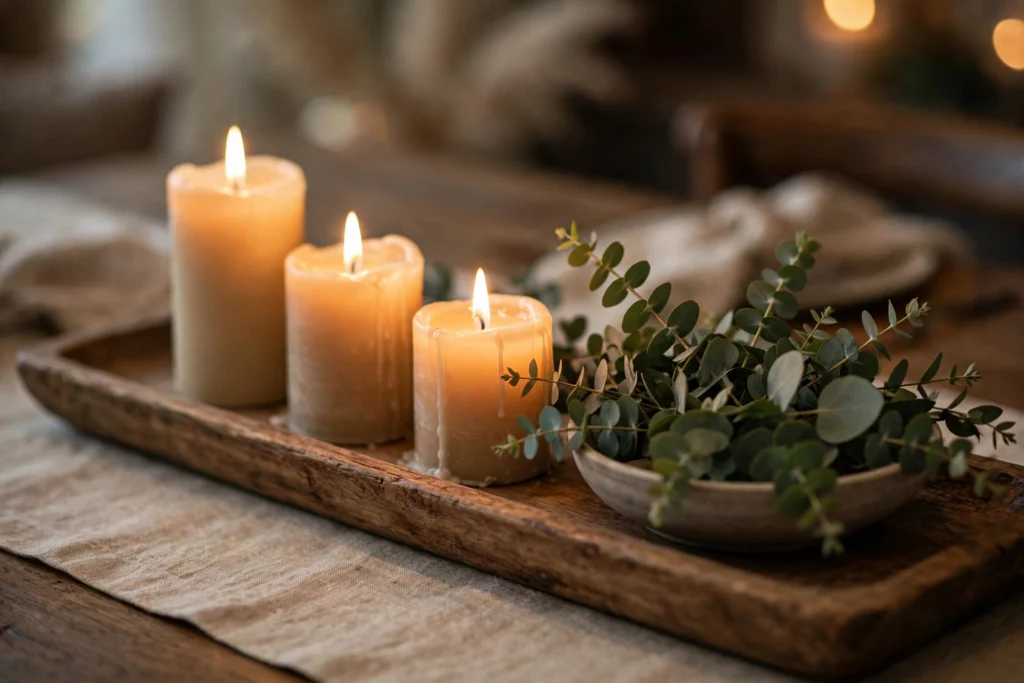
How to do it: Keep arrangements under 12 inches tall, or go dramatically tall and narrow (over 24 inches) so sightlines pass underneath. On rectangular tables, run a low linear arrangement — a wooden tray with three pillar candles and a low bowl of greenery works every time. On round tables, use one central cluster: a small plant, a candle, and a decorative object in varied heights.
What to avoid: Avoid strongly scented flowers or candles at the table — fragrance competes with food. Do not leave a heavy, immovable centerpiece on a table that needs to clear for homework or projects.
6. Size the Rug So Chairs Stay On It
A dining rug grounds the table and softens the room’s acoustics, but only if it is large enough. An undersized rug with chair legs half-on, half-off looks worse than no rug at all — and chairs catch on the edge every time someone sits down.
How to do it: Choose a rug that extends at least 24 inches beyond the table on every side, so chairs stay on the rug even when pulled out. An 8×10-foot rug suits most six-seat tables. Low-pile, washable, or indoor-outdoor rugs are the practical choice under a dining table — spills are a matter of when, not if.
What to avoid: Avoid high-pile rugs that make chairs wobble and trap crumbs. Do not place a rug under the table that stops short of the chairs. For more small-space rug strategy, see our small living room decor ideas guide.
7. Add a Sideboard or Buffet for Storage and Styling
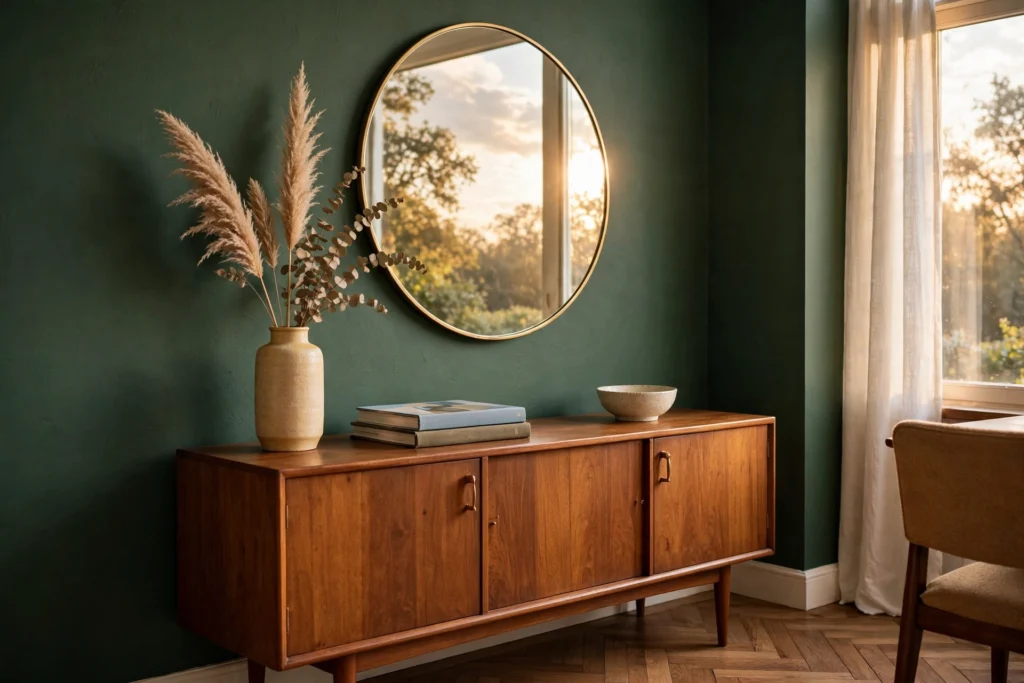
A sideboard turns a dining room from a table in a room into a finished space. It hides serving pieces, linens, and the clutter of daily life, and its top surface becomes the room’s best styling stage.
How to do it: Choose a sideboard 30–36 inches tall so its top works as a serving surface. Leave 36 inches between it and the table for chair clearance. Style the top in an odd-numbered grouping: a tall lamp or vase, a stack of two art books, and one small bowl or plant. Anchor it with art or a mirror hung above.
What to avoid: Avoid stuffing the sideboard top with a dozen small objects — it reads as clutter, not styling. Do not buy deeper than the clearance allows; measure twice, since 36 inches of walkway is non-negotiable.
8. Hang One Strong Art Piece at True Eye Level
Dining room walls often sit empty because people are unsure what belongs there. One confident piece of art, hung correctly, finishes a wall more effectively than a timid cluster of small frames.
How to do it: Hang the center of the piece 57–60 inches from the floor — true eye level, which feels lower than most people expect. Size the art to roughly two-thirds the width of the furniture below it. Abstract landscapes, botanical prints, and food-adjacent still lifes all suit dining rooms; choose colors that echo the room’s palette.
What to avoid: Avoid hanging art at “standing in a gallery doorway” height — dining rooms are experienced seated, so slightly lower is better. Do not use glass directly opposite a bright window; the glare ruins the piece. For gallery-wall technique, see our modern hallway decor ideas post.
9. Use a Mirror to Bounce Light Around the Room
Dining rooms are often interior-facing and a little dim, especially at breakfast. A mirror placed to catch window light effectively adds a second light source for free, and it makes the room feel larger and more festive at night when it doubles the candlelight.
How to do it: Hang a large mirror on the wall adjacent to (not directly opposite) the main window so it catches and throws light across the room rather than bouncing glare back. A leaning floor mirror beside the sideboard works in rooms where wall space is tight. Keep the frame finish consistent with the room’s metals.
What to avoid: Avoid mirrors that reflect a blank wall or the kitchen mess — a mirror doubles whatever it faces. Do not hang a mirror where seated diners stare at themselves; adjacent-wall placement solves this.
10. Soften Hard Surfaces with Curtains or Drapes
Dining rooms are full of hard surfaces — table, chairs, floors, walls — which is why they can feel echoey and stark. Fabric is the fix: curtains add softness, absorb sound, and make the room feel dressed rather than furnished.
How to do it: Hang the curtain rod 4–6 inches above the window frame and extend it 6–10 inches beyond each side so the window looks larger and panels stack clear of the glass. Choose panels long enough to just kiss the floor. Linen or linen-look fabrics suit dining rooms — relaxed but tailored.
What to avoid: Avoid short curtains that end at the sill — they make windows look smaller and the room feel unfinished. Do not choose heavy blackout fabrics unless the room doubles as a media space; dining rooms want filtered light.
11. Set a Calm, Appetizing Color Palette
Color psychology matters at the table: warm, enveloping colors make people linger, while cold or chaotic palettes hurry them along. The dining room is the one room where a moody wall color genuinely earns its keep.
How to do it: Build around warm neutrals — warm white, greige, soft taupe — then add depth with one saturated color on an accent wall or the wainscoting: deep green, ink navy, or warm terracotta. These shades flatter candlelight and make wood tones glow. Keep the ceiling light to preserve a sense of height.
What to avoid: Avoid painting the whole room a dark color if it gets little natural light — one moody wall plus light surroundings is the safer move. Do not introduce more than three main colors; dining rooms feel calmest with a restrained palette.
12. Finish with Table Linens and Living Greenery
The final layer is what makes a dining room feel alive day to day: a runner that stays on the table, placemats that come out for meals, and something green that proves the room is tended.
How to do it: Keep a simple runner or a set of placemats on the table permanently — a bare table between meals looks abandoned. Add one living element: a small potted herb, a vase of eucalyptus stems, or a bowl of seasonal fruit. Rotate the greenery with the seasons for a room that always feels current.
What to avoid: Avoid plastic-looking faux plants in the room’s most visible spot — real greenery is cheap and the difference is obvious. Do not leave formal place settings out permanently; they collect dust and signal a room nobody uses.
Frequently Asked Questions
What are the best dining room decor ideas for a small space?
Choose a round pedestal table (no corner legs to bump), add a mirror on an adjacent wall to double the light, keep the palette light and warm, and use a sideboard instead of a bulky china cabinet. Clear 36-inch walkways matter even more in small rooms.
How high should a chandelier hang above a dining table?
Hang the bottom of the fixture 30–34 inches above the tabletop for standard 8-foot ceilings; raise it a few inches for taller ceilings. The fixture should span about one-half to two-thirds of the table’s width.
What size rug goes under a dining table?
The rug should extend at least 24 inches beyond the table on all sides so chairs remain on the rug when pulled out. For a typical six-seat table, an 8×10-foot rug is the standard choice. Choose low-pile and washable.
How can I make my dining room feel cozier?
Layer warm lighting with a dimmer, add textiles (rug, curtains, upholstered chairs), paint one wall a deep warm color, and keep a low centerpiece with candles. Softness and warm light are what read as “cozy.”
What colors work best in a dining room?
Warm neutrals (warm white, greige, soft taupe) as the base, with deep green, ink navy, or terracotta as accents. These shades flatter both daylight and candlelight and make wood furniture glow.
Sources
- ENERGY STAR — residential lighting and fixture guidance
- National Association of Home Builders — residential space planning guidelines
- American Lighting Association — fixture sizing and placement guidance