
Hallways are the most walked-through and least decorated rooms in most homes — a strip of wall between here and there that gets ignored because it feels too narrow, too dark, or too plain to bother with. That is exactly why great modern hallway decor ideas make such a difference: a few deliberate choices turn a forgotten passage into a confident first impression. The twelve ideas below are practical and renter-friendly, each with exactly how to do it plus what to avoid.
1. Create a Gallery Wall with a Modern Grid: One of the Strongest Modern Hallway Decor Ideas
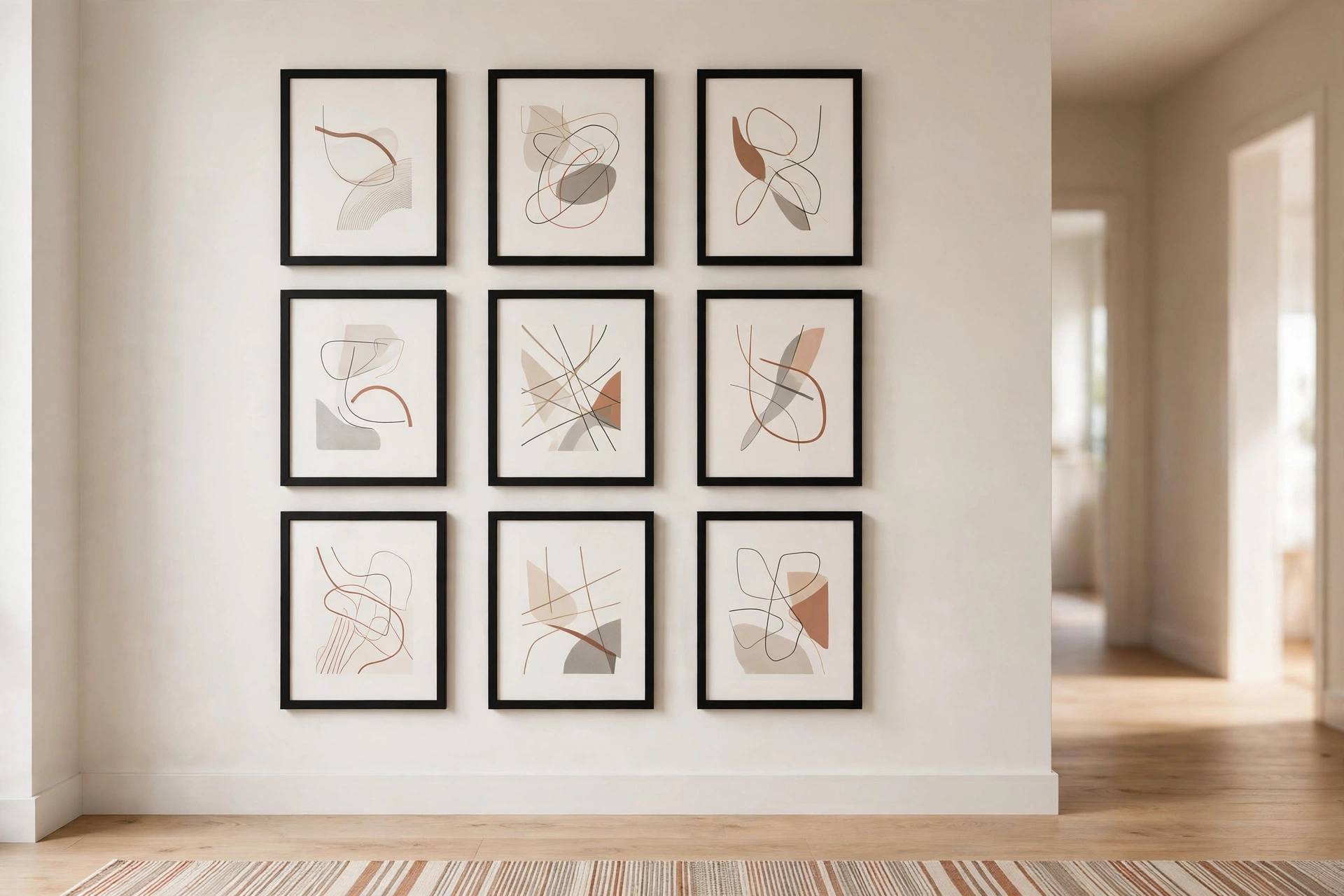
A gallery wall is the classic hallway move, and it works best with a clean modern grid — evenly spaced frames in identical sizes, aligned in straight rows and columns. The grid reads as deliberate design, which suits the long, linear geometry of a hallway perfectly.
How to do it: Choose one frame size (11×14 or 12×16 inches works well) and one finish — matte black, white, or natural oak. Space frames 2–3 inches apart with the center line at 58–60 inches from the floor. Mix abstract prints, line art, and one or two photographs.
What to avoid: Avoid mixing five different frame styles and colors — it turns modern into messy. Do not hang frames above head height, and skip anything on the narrowest stretch where shoulders will brush past it.
2. Run a Bold Runner Rug the Full Length
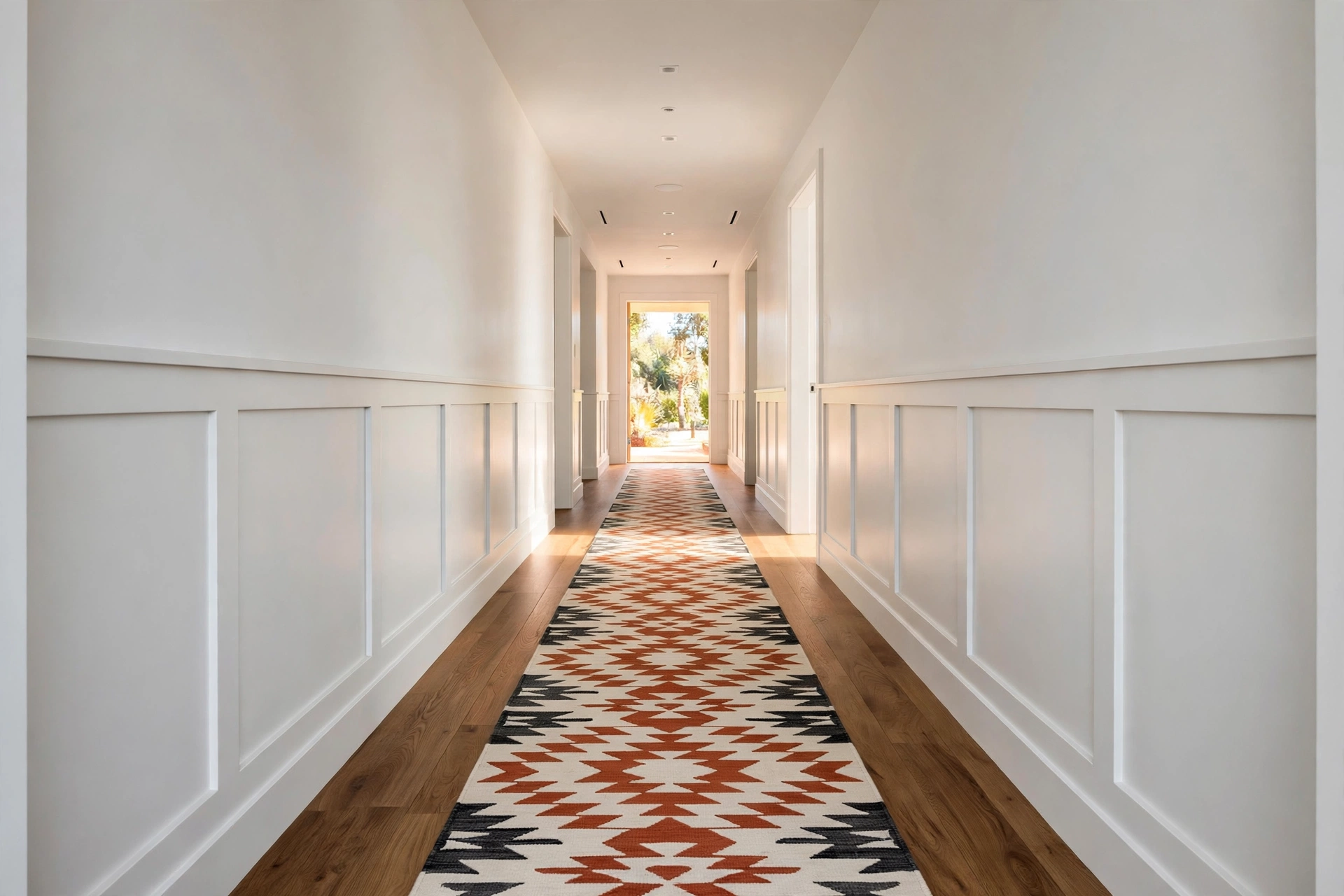
Nothing transforms a hallway faster than a long runner rug. It adds color, pattern, and softness underfoot, and guides the eye from one end to the other. In modern hallways, a graphic runner also breaks up long expanses of wood or tile flooring.
How to do it: Choose a runner that leaves 4–6 inches of bare floor visible on each side; a 2.5×8 or 2.5×10-foot runner suits most hallways. Low-pile, washable rugs are the smart choice for high-traffic corridors. For a modern look, go for geometric patterns or a bold stripe.
What to avoid: Avoid thick, high-pile runners that snag on doors opening over them — check door clearances first. Skip runners that end mid-hallway, and always use a rug pad or a non-slip backing.
3. Paint One Wall (or Just the Ceiling) a Statement Color
A hallway is the ideal low-risk place for a confident color moment because it is transitional — you pass through it, you do not sit in it. One wall or the ceiling in deep green, ink navy, or warm terracotta adds instant depth.
How to do it: Paint the longest wall, or the wall at the dead end, in a saturated color; this visually shortens an over-long corridor and gives it a destination. Pair the color with a light runner so the space does not go gloomy.
What to avoid: Avoid painting all four walls plus the ceiling dark unless the hallway has strong natural light — it becomes a tunnel. Do not choose the color in isolation; relate it to the rooms the hallway connects.
4. Upgrade the Lighting with Statement Sconces or Pendants
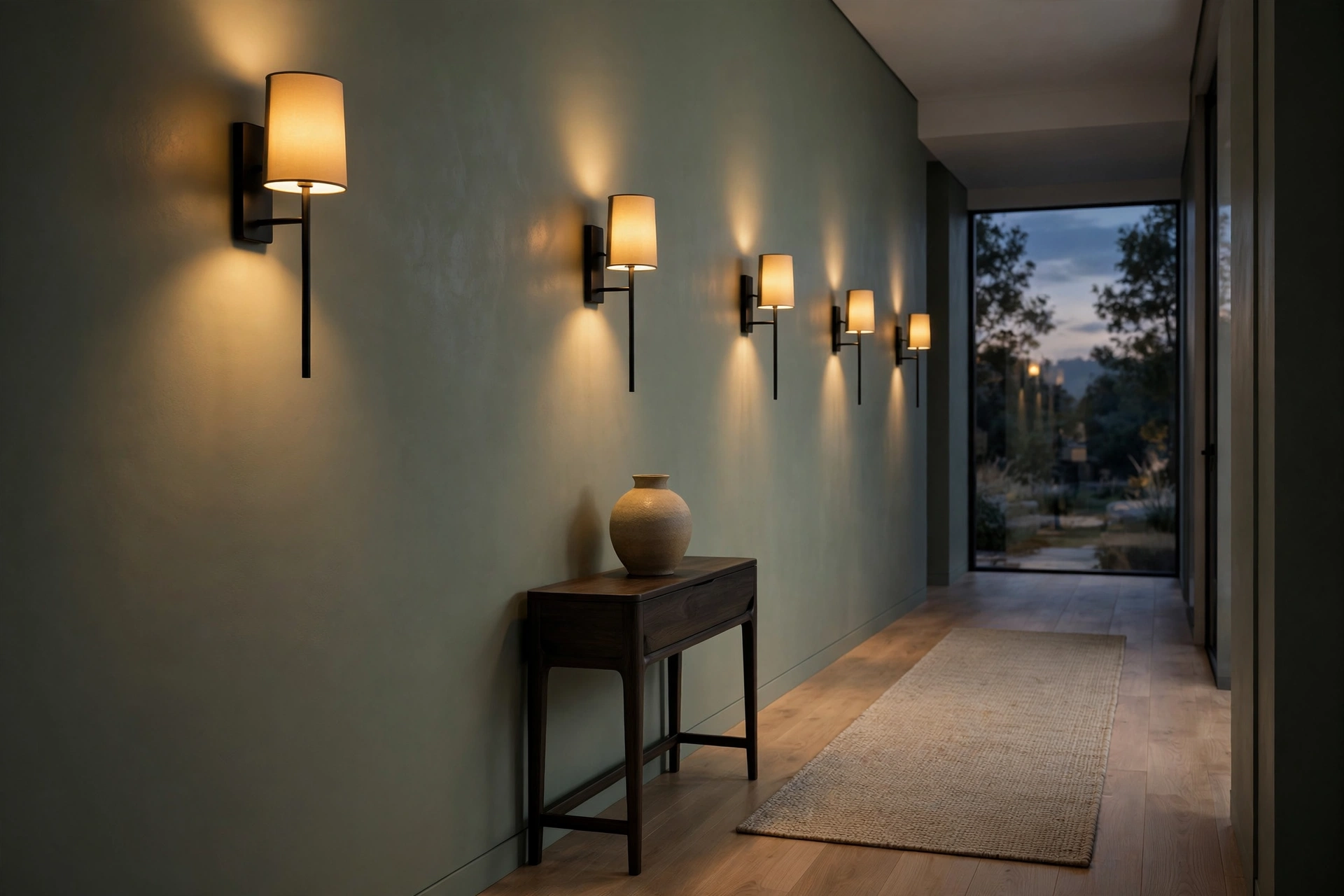
Most hallways suffer from one sad flush-mount fixture casting flat light. Modern hallway lighting layers small, characterful fixtures down the length of the passage — slim wall sconces or a row of small pendants — turning the ceiling line into a design feature.
How to do it: For standard 8-foot ceilings, space semi-flush fixtures 6–8 feet apart; in taller hallways, a row of small pendants hung at the same height creates rhythm. Use warm-white bulbs (2700–3000K) and, where possible, ENERGY STAR certified fixtures to keep energy use down. Renters can use plug-in sconces with cord covers.
What to avoid: Avoid cool daylight bulbs (5000K+) — they feel institutional. Do not mix warm and cool bulbs in adjacent fixtures. Skip oversized chandeliers in standard-height hallways; they hang too low.
5. Add a Slim Console Table with Styling Layers
A narrow console table gives the hallway a functional anchor — a place for keys, a lamp, and a few styled objects — without blocking traffic, and gives guests somewhere to put things down the moment they arrive.
How to do it: Choose a console no deeper than 10–12 inches so it hugs the wall. Style it in three layers: something tall (a lamp or vase with branches), something flat (a stack of two books or a key tray), and something organic (a small plant or bowl). Anchor it with art or a mirror above.
What to avoid: Avoid consoles deeper than 12 inches — walkways need at least 36 inches of clear width. Do not let it become a mail dumping ground; the tray rule keeps it styled. For more small-space furniture strategies, see our small living room decor ideas guide.
6. Hang a Large Mirror to Double the Light
Mirrors are a hallway superpower: they bounce light into dark corridors, double the sense of width, and give you a last check on the way out. A single large mirror reads far more modern than a cluster of small ones.
How to do it: Hang one oversized mirror (at least 30×40 inches) on the wall opposite the main light source so it reflects light down the corridor. Keep the frame thin and simple: black metal, brass, or frameless.
What to avoid: Avoid placing a mirror directly opposite another mirror — the infinite reflection serves no purpose. Do not hang it where it reflects a cluttered view; it will double the mess.
7. Install Floating Shelves for Art and Objects
Floating shelves let you display art, ceramics, and small plants without committing to a permanent gallery wall, and you can rearrange the display in minutes. In a hallway, one or two long shelves keep the look sleek and modern.
How to do it: Mount shelves at least 60 inches from the floor and keep them shallow (6–8 inches deep). Lean two or three art prints against the wall, add a trailing plant, and leave breathing room between groupings.
What to avoid: Avoid shelves deeper than 8 inches — protruding objects become shoulder hazards. Do not overload them with tiny knick-knacks; a few larger pieces read as modern. Anchor into studs — falling shelves in a walkway are dangerous.
8. Use Wainscoting or Board-and-Batten for Architectural Interest
Plain drywall hallways feel flat; adding wainscoting, board-and-batten, or simple picture-frame molding gives the walls architectural depth for very little money — the visual payoff far exceeds the effort.
How to do it: Install molding to chair-rail height (about 36 inches) or go floor-to-ceiling with vertical slats for a contemporary look. Paint the molding the same color as the wall for subtle texture, or go dark molding with a light wall above for drama. Peel-and-stick kits make this a genuine weekend project.
What to avoid: Avoid ornate, fussy molding profiles — flat shaker-style trim suits a modern look. Do not install molding so thick it eats into an already narrow walkway.
9. Bring in Greenery That Tolerates Low Light
Plants soften the hard lines of a hallway and add life to a space that is mostly wall and floor. Because hallways are often dim, choose species that genuinely tolerate low light rather than fighting for sun in the wrong spot.
How to do it: Snake plants, pothos, ZZ plants, and cast-iron plants all survive low-light hallways. Use a tall floor plant at the dead end to create a “destination,” or hang a pothos from a high hook. Choose planters that match your palette — matte ceramic in white, black, or terracotta.
What to avoid: Avoid sun-loving plants (fiddle-leaf figs, succulents) in dark hallways — they slowly decline and look worse than no plant at all. Do not block the walkway; keep at least 36 inches of clear path.
10. Style the Dead End with a Moment of Interest
Every hallway has a dead end — the wall you face at the end of the corridor — and it is the most visible surface in the passage. Styling it deliberately gives the hallway a focal point and a sense of arrival.
How to do it: Treat the end wall like a stage: one hero piece plus one supporting element. A large abstract painting above a slim bench, or a tall plant in a statement planter, both work. Keep it uncluttered — this wall is seen from the farthest distance, so simplicity reads best.
What to avoid: Avoid leaving the end wall bare — it reads as unfinished. Do not clutter it with many small items; from a distance they blur into noise. Skip furniture that blocks the doorway at the end.
11. Keep Sightlines Clean — The Invisible Design Rule
Because hallways connect rooms, what you see through the hallway matters as much as what is in it. Keeping the view from one end clear and composed makes the whole home feel more orderly and spacious.
How to do it: Stand at each end and note what you see: the goal is a clear view to an inviting destination (a styled end wall, a window, an art piece). Remove anything that breaks the sightline at eye level — jutting coat hooks, doors swinging into the path, items stacked on the floor.
What to avoid: Avoid placing the tallest or brightest object at the entrance where it blocks the view inward. Do not line both walls with deep furniture. For more on clearing visual clutter, see our budget kitchen organization ideas post.
12. Finish with Details: Door Hardware, Switch Plates, and Scent
The difference between a styled hallway and a finished hallway is in the small details. Matching modern door handles, clean switch plates, and a subtle scent make the passage feel considered from the first step to the last.
How to do it: Swap mismatched door knobs for one consistent modern handle style — matte black or brushed brass levers suit most interiors. Replace yellowed switch plates with fresh white or metal ones. Add a reed diffuser at the entry end.
What to avoid: Avoid mixing three different metal finishes — pick one or two and commit. Do not use overpowering fragrance; a hallway is a small enclosed space. Skip novelty doorstops that undercut the finished look.
Frequently Asked Questions
What are the best modern hallway decor ideas for a narrow hallway?
Focus on wall-mounted and slim-profile solutions: a grid gallery wall, a low-pile runner, one large mirror, slim sconces, and low-light plants. Keep furniture under 12 inches deep and maintain at least 36 inches of clear walking width.
How do I make a dark hallway feel brighter?
Layer warm lighting (sconces or pendants at 2700–3000K), hang a large mirror opposite the main light source, use a light-colored runner, and paint walls in light, reflective tones. See our cozy bedroom decor ideas for more on layered warm lighting.
What color should I paint my hallway?
Light, warm neutrals (warm white, greige, soft beige) keep narrow hallways feeling open. For drama, paint one accent wall in deep green, ink navy, or terracotta and keep the rest light. Relate the color to the rooms the hallway connects.
How wide should a hallway runner rug be?
Leave 4–6 inches of bare floor visible on each side. For a standard 3-foot-wide hallway, a 2.5-foot-wide runner is ideal, and it should run most of the hallway’s length rather than stopping halfway.
Can renters do these modern hallway decor ideas?
Most of them, yes: gallery walls with removable hooks, runners, plug-in sconces, leaning mirrors, freestanding consoles, plants, and peel-and-stick molding are all renter-friendly. Skip permanent changes like painting unless your landlord approves.
Sources
- ENERGY STAR — residential lighting and fixture guidance
- National Association of Home Builders — hallway width and residential design guidelines