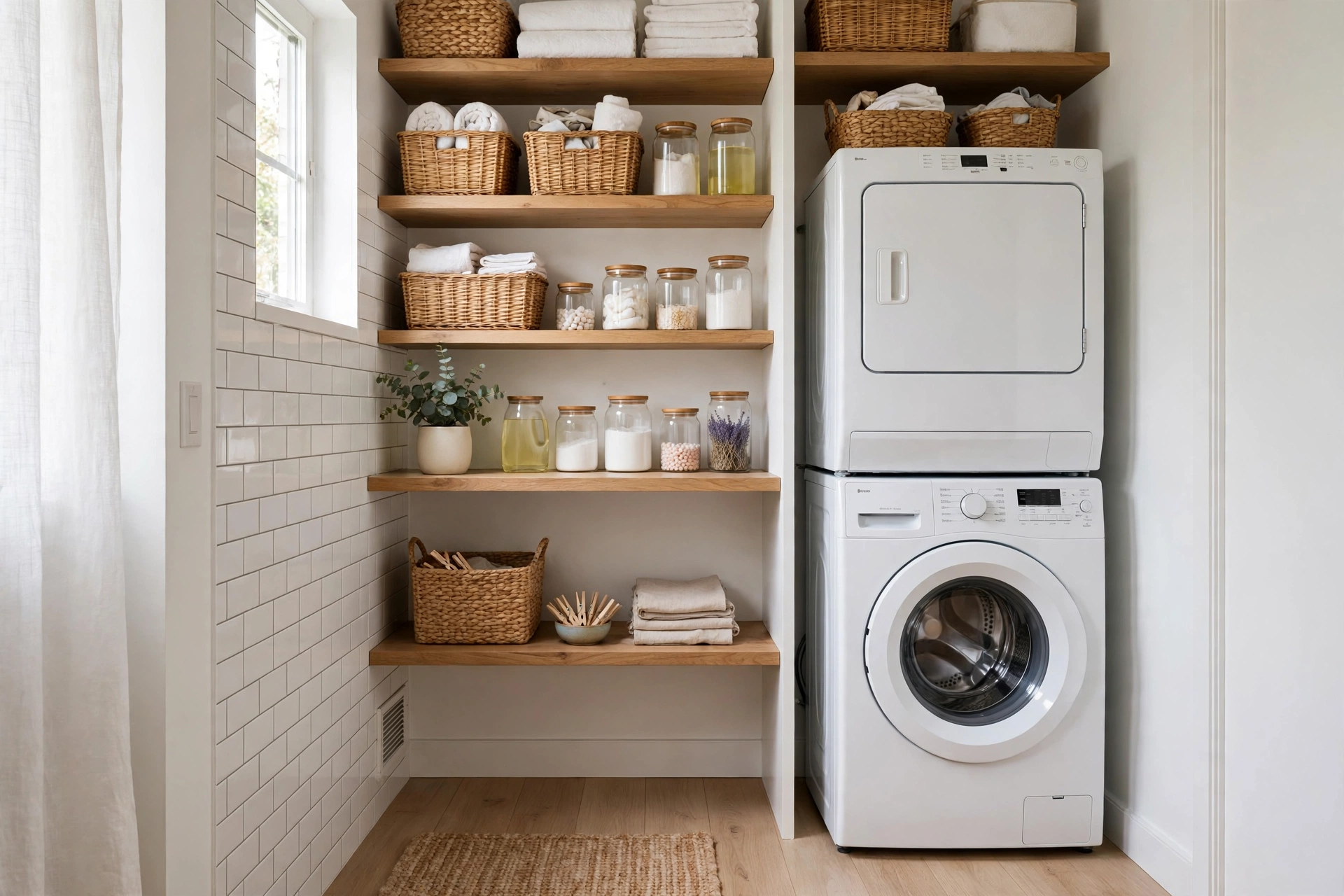
A laundry room does not need to be large to work well — it needs to be organized. In a tight space, every inch earns its keep: vertical storage replaces floor clutter, machines pull double duty as counter space, and slim organizers capture gaps you did not know existed. These ten small laundry room organization ideas show exactly how to set up each one, with measurements and the mistakes to avoid.
1. Stack Your Machines: The Cornerstone of Small Laundry Room Organization Ideas
Of all small laundry room organization ideas, stacking the washer and dryer delivers the biggest space gain in a single move: it frees half the floor area the machines used to occupy. That reclaimed space becomes a folding zone, a hamper station, or simply room to move — transformative in rooms under 50 square feet.
How to do it: Use the manufacturer’s own stacking kit (never a generic shelf) to secure the dryer on top of the washer, and confirm the pair is stackable before buying — front-loaders are designed for this; most top-loaders are not. Plan for 72–75 inches of vertical clearance, and set anti-vibration pads under the washer’s feet to keep the stack quiet and stable. Keep 4–6 inches behind the machines for hoses and vents.
What to avoid: Avoid assuming any washer-dryer pair can stack — mismatched brands and top-load models are the classic regret. Do not skip the stacking kit; a dryer balanced “carefully” on a washer is a disaster waiting for a spin cycle. Leave access to the water shutoff valves; a stack you cannot reach behind is a stack you cannot service.
2. Run Wall-Mounted Open Shelving Above the Machines
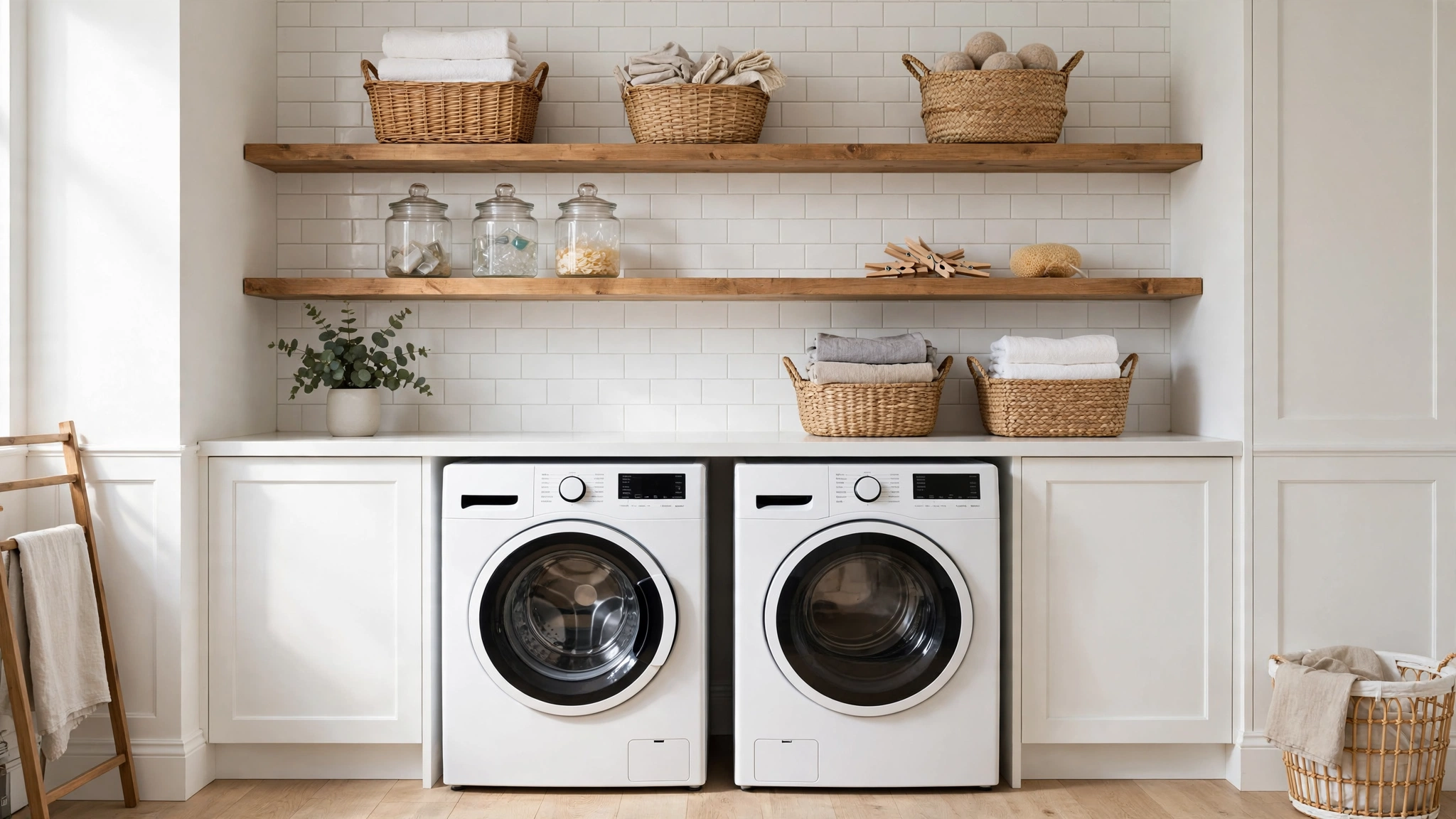
The wall above the washer and dryer is dead space in most laundry rooms — prime real estate for detergent, baskets, and cleaning supplies. Two rows of open shelving turn that air into the room’s main storage.
How to do it: Mount 12–16 inch deep shelves (shallow enough to reach over the machines, deep enough for detergent bottles) with the lowest shelf 18–24 inches above the machine tops. Use brackets rated for the load and drive them into studs — laundry shelves carry heavy bottles. Keep daily-use detergent on the lower shelf and backup supplies up high. Uniform baskets or bins on the shelves hide visual clutter and make everything grab-and-go.
What to avoid: Avoid shelves deeper than 16 inches above front-loaders — you will bump your head reaching past them. Do not overload shelves directly above a washer that vibrates; secure brackets and keep the heaviest items low. Skip wire shelving without liners if small items fall through.
3. Slide In a Pull-Out Cart for Detergent and Supplies
Pull-out organizers turn a narrow unused gap — beside the machines, between cabinet and wall — into deep, accessible storage. They roll out to reveal everything, so nothing hides at the back the way it does on a fixed shelf.
How to do it: Measure the gap first; slim pull-out carts come in 6, 8, and 10-inch widths. Choose one with at least three tiers and a stable base that will not tip when extended. Stock it by frequency: detergent and stain remover on top, dryer sheets and specialty products below. Lock the casters or choose a model with a brake so it stays put during use.
What to avoid: Avoid buying before measuring — a cart even half an inch too wide is useless. Do not overload the top tier with heavy jugs; keep the weight low for stability. Skip carts without side rails; bottles slide off smooth shelves in transit.
4. Use the Back of the Door: Over-Door Racks and Hooks
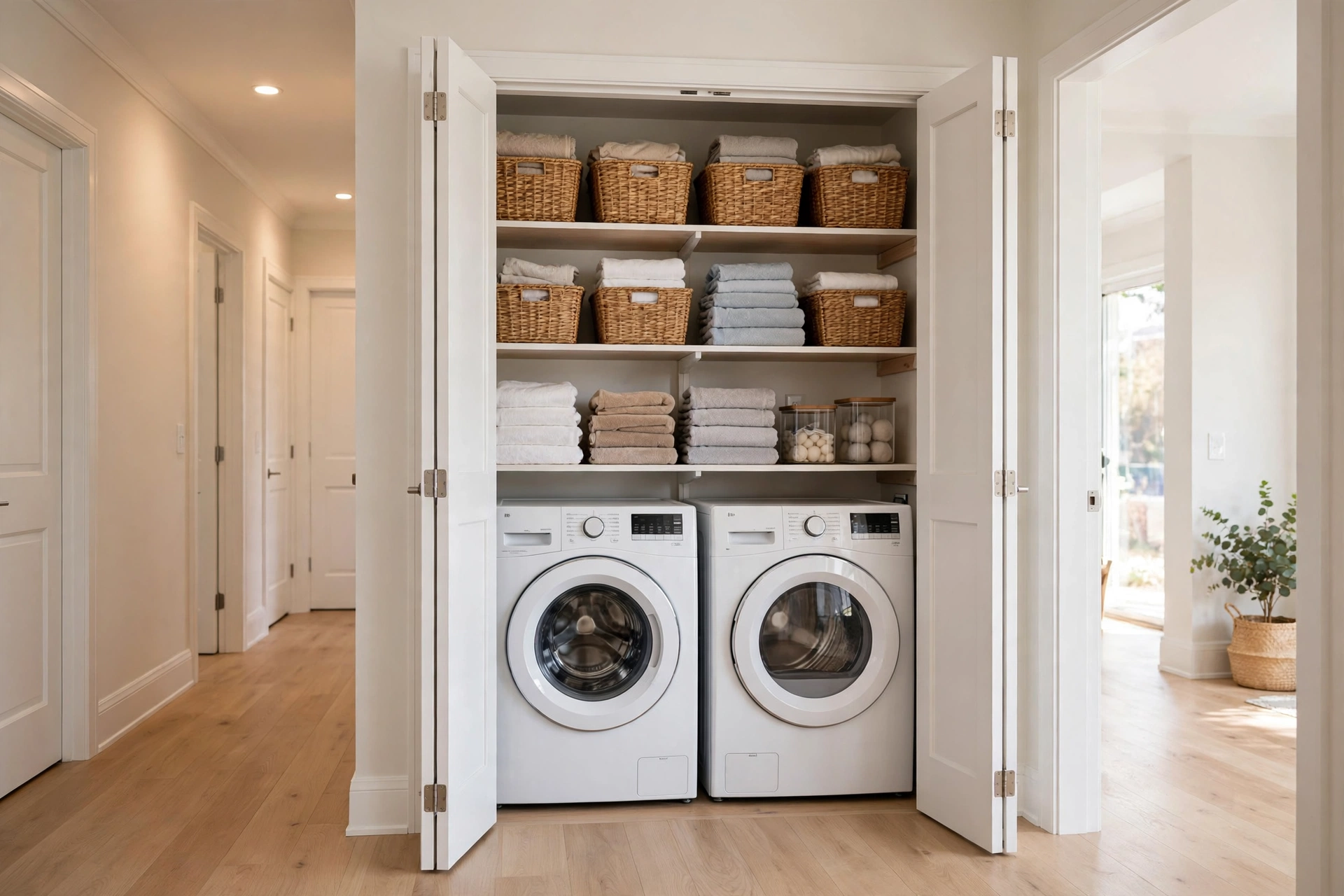
The back of the laundry room door is square footage you already own but probably are not using. Over-door racks, hooks, and organizers add a full column of storage with zero floor space and no drilling.
How to do it: Hang a slim over-door wire rack for spray bottles, lint rollers, and clothespins, keeping the profile under 4 inches so the door still closes. Add adhesive or over-door hooks for the ironing board, a drying rack, and the broom. If the door is hollow-core, keep loads light — hooks and racks, not full shelving units. For bi-fold or sliding closet doors, use the inside face of each panel the same way.
What to avoid: Avoid heavy over-door organizers on hollow-core doors — they warp the door and strain the hinges. Do not block the door’s swing path with a protruding rack. Skip metal racks in humid laundry rooms without a rust-resistant coating.
5. Add a Folding Counter Over Front-Load Machines
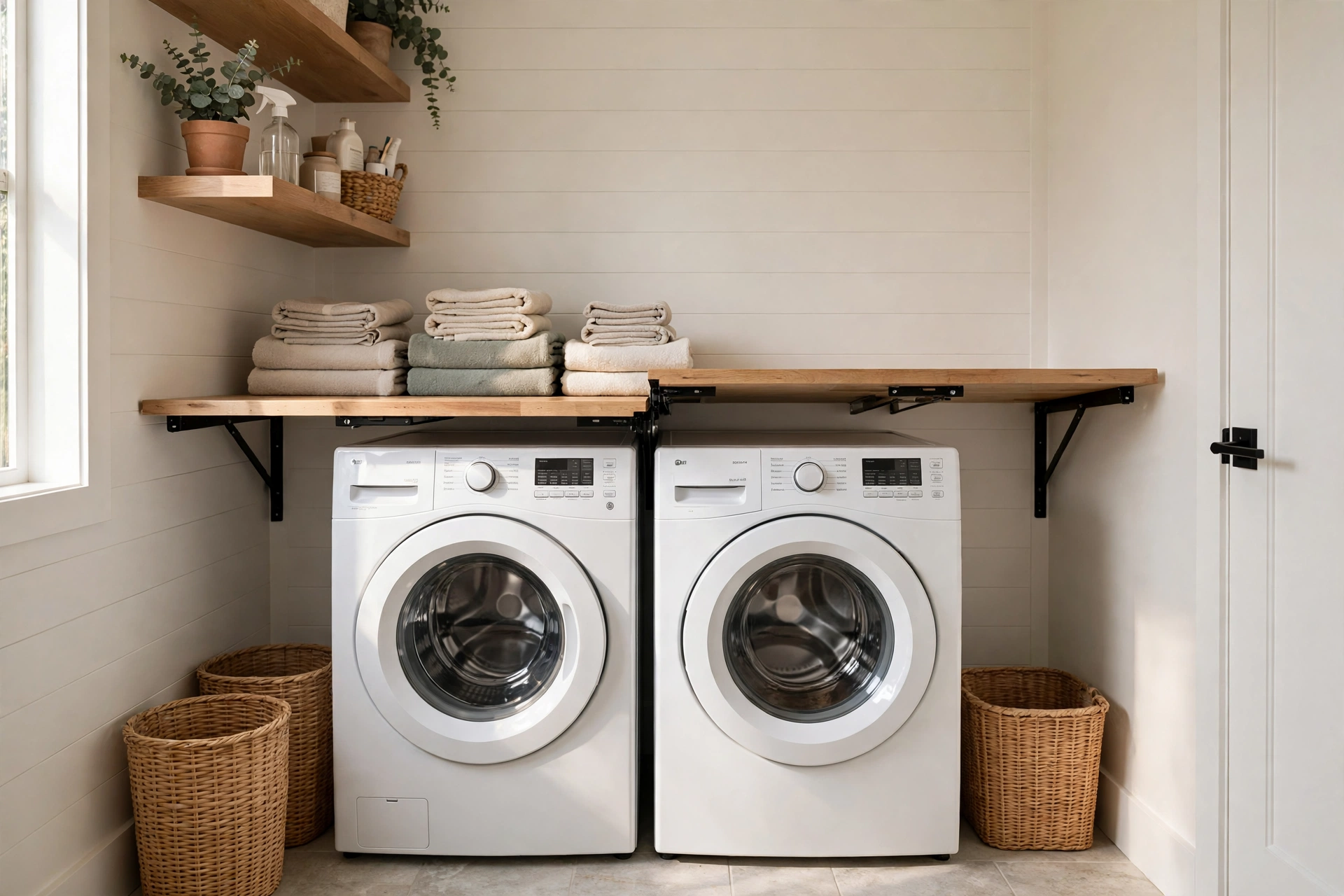
A folding counter converts the top of front-load machines from a cluttered shelf into a real work surface. Folded laundry has somewhere to land besides the bed, and sorting becomes a standing task instead of a floor task.
How to do it: Set a 3/4-inch plywood or butcher-block counter at about 36 inches high, supported by cleats on the side walls or legs at the front — never resting directly on the machines, which vibrate. Leave a 1-inch gap on each side of the machines so the counter does not rattle. Seal wood with polyurethane to protect against damp laundry. Our budget kitchen organization ideas guide covers the same countertop-install basics that apply here.
What to avoid: Avoid a fixed counter over top-load washers — the lids need to open. Do not let the counter trap heat and moisture against the machines; the side gaps matter. Skip raw, unsealed wood; laundry rooms are humid and unfinished wood warps.
6. Sort with Stackable Hampers and Pull-Out Sorters
Sorting laundry at the hamper stage cuts wash day in half — and in a small room, one giant hamper eats floor space while doing nothing else. A three-bin sorter (lights, darks, delicates) or stackable hampers do the same job in a slimmer footprint.
How to do it: Choose a slim three-bag sorter on a rolling frame; it fits in a 24-inch-wide slot and rolls out for loading. Alternatively, stack two or three lidded hampers vertically — one per category. Label each bag or hamper so the whole household sorts correctly. Position the sorter where dirty laundry naturally lands, ideally within arm’s reach of the washer.
What to avoid: Avoid one oversized hamper “for everything” — it forces full sorts on wash day and overflows in a small room. Do not place sorters across the room from the washer; every step is friction. Skip fabric sorters without ventilation in humid rooms; mildew is a real risk.
7. Install a Cabinet Above the Machines for Hidden Storage
Open shelves are great for daily items, but every room needs hidden storage for the unsightly: spare parts, bulk detergent, the vacuum attachments. A wall cabinet above the machines keeps the room looking calm while swallowing the overflow.
How to do it: Mount a 12-inch-deep wall cabinet 18–24 inches above the machines — deep enough for detergent jugs, shallow enough to reach into over the machines. Keep doors closed for visual calm; what you see least bothers you least. Reserve the cabinet for backups and infrequent items, and keep daily detergent on the open shelf where it is grabbable. Use the same door style as nearby rooms so the laundry corner feels intentional.
What to avoid: Avoid cabinets deeper than 12–15 inches above front-loaders; you cannot reach the back without climbing. Do not let cabinet doors swing into your head — side-hinged doors on a wide cabinet need clearance planning. Skip storing cleaning chemicals directly above the dryer’s heat vent.
8. Mount a Pegboard or Rail for Tools and Supplies
Small tools — spray bottles, the iron, scissors, lint rollers — vanish into drawers and reappear exactly when you do not need them. A pegboard or wall rail gives every tool a visible, assigned hook on otherwise wasted wall space.
How to do it: Mount a 24×36 inch pegboard on a side wall or the inside of a closet door, secured into studs with a 3/4-inch standoff so hooks seat properly. Arrange hooks by task: stain treatment, ironing, mending. A stainless rail with S-hooks is the sleeker alternative and holds spray bottles in hanging caddies. Keep the board clear of the washer lid swing and dryer door.
What to avoid: Avoid hanging a loaded pegboard on drywall anchors alone — detergent and irons are heavy; studs are non-negotiable. Do not place the pegboard where the washer lid or a swinging door hits it. Skip overloading one small board; spread tools across two boards rather than cramming.
9. Tuck a Slim Rolling Cart Between or Beside the Machines
The 6-to-8-inch gap between machines — or between a machine and the wall — is the most wasted space in small laundry rooms. A slim rolling cart slides into exactly that slot and pulls out with three tiers of storage on demand.
How to do it: Measure the gap at both the front and back (rooms are rarely square) and buy a cart narrower than the tightest measurement. Three-tier carts hold detergent, dryer sheets, and stain sticks within arm’s reach of the machines. Choose a cart with a handle and locking casters so it pulls out smoothly and parks firmly. Stainless or plastic carts handle laundry humidity best.
What to avoid: Avoid blocking water valves, the dryer vent, or the electrical outlet behind the cart — leave everything serviceable. Do not buy before measuring at multiple points; a cart that fits at the front may wedge at the back. Skip fabric-tier carts; they sag under detergent weight.
10. Organize Doors and Drawers with Bins, Labels, and Dividers
Cabinets and drawers only count as storage if you can find things in them. Uniform bins, drawer dividers, and clear labels turn a chaotic cabinet into a system — and decanting detergent into pump bottles makes daily dosing faster and spill-free. The same bin-and-label method powers our budget bathroom makeover ideas storage upgrades.
How to do it: Use one bin style in one color throughout — uniformity is what reads as “organized.” Label every bin with a label maker or waterproof tags: detergent, delicates bags, stain treatment, rags. Add drawer dividers so small items (clothespins, dryer balls, sewing kit) stop migrating. Decant powder and pods into sealed, clearly marked containers kept out of children’s reach. If the laundry shares space with a hallway closet, our small living room decor ideas post covers folding-door styling that keeps utility corners looking intentional.
What to avoid: Avoid mismatched containers in five colors — visual chaos undoes the organizing work. Do not store pods or chemicals where children can reach, even in “safe” containers. Skip over-labeling every tiny item; label categories, not individual objects.
Frequently Asked Questions
What are the best small laundry room organization ideas with no built-in storage?
Start vertical: wall-mounted shelves above the machines, an over-door rack on the door, and a pegboard on the side wall add three full storage zones with zero floor space. Add one slim rolling cart for the gap between machines. These four moves alone can double usable storage in a storage-free laundry corner.
Can I stack any washer and dryer?
No. Only front-load washers designed for stacking, paired with a compatible dryer and the manufacturer’s own stacking kit, should be stacked. Top-load washers cannot be stacked because the lid must open, and mismatched brands rarely align safely. Check both manuals before buying.
What is the best way to store detergent in a small laundry room?
Keep the working bottle on the lowest open shelf within arm’s reach of the washer, decant powder or pods into sealed pump containers to save space, and store bulk backups in a closed wall cabinet. Never store detergent where it can spill onto electrical connections.
How deep should shelves be above a washer and dryer?
Twelve to sixteen inches: deep enough for detergent bottles and baskets, shallow enough to reach over the machines without bumping your head. Mount the lowest shelf 18–24 inches above the machine tops, and always drive brackets into studs.
How can I make a laundry closet look tidy?
Uniform bins in one color, closed cabinet doors, a folding counter to hide machine tops, and bi-fold doors that close fully when guests come. Consistent finishes — matching baskets, one metal tone — make even a working closet look designed. The ENERGY STAR site also notes that efficient washers from certified models use significantly less water and energy, so an organized closet can pair with an efficient machine upgrade.
Sources
- ENERGY STAR — clothes washer efficiency and certified product guidance
- National Association of Home Builders — residential space planning guidelines
- U.S. Department of Energy — laundry energy-saving tips